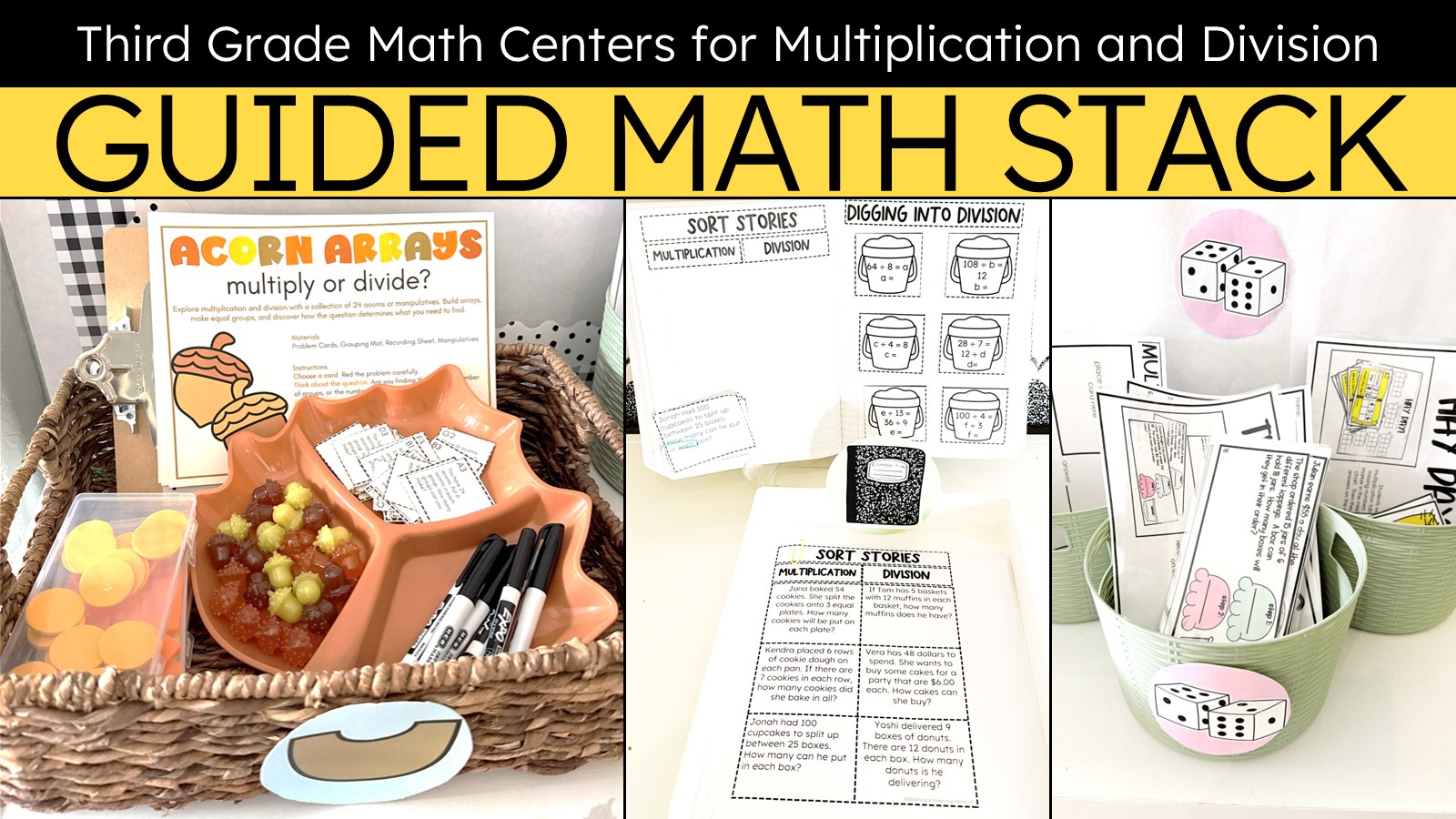
Third Grade Multiplication and Division Math Stations
Teaching students to multiply and divide involves more than practicing equations. Students need to recognize equal groups, decide what a problem is asking, and explain how their model connects to an equation.
These third grade multiplication and division math stations show how I connect that work across Guided Math STACK, from a teacher-led small group to technology, independent application, math journals, and hands-on math stations.
The focus is multiplication and division problem solving. Start with the free Acorn Arrays activity, then take a look at how the other stations give students opportunities to use and extend their learning.
How the Guided Math STACK Math Stations Fit Together
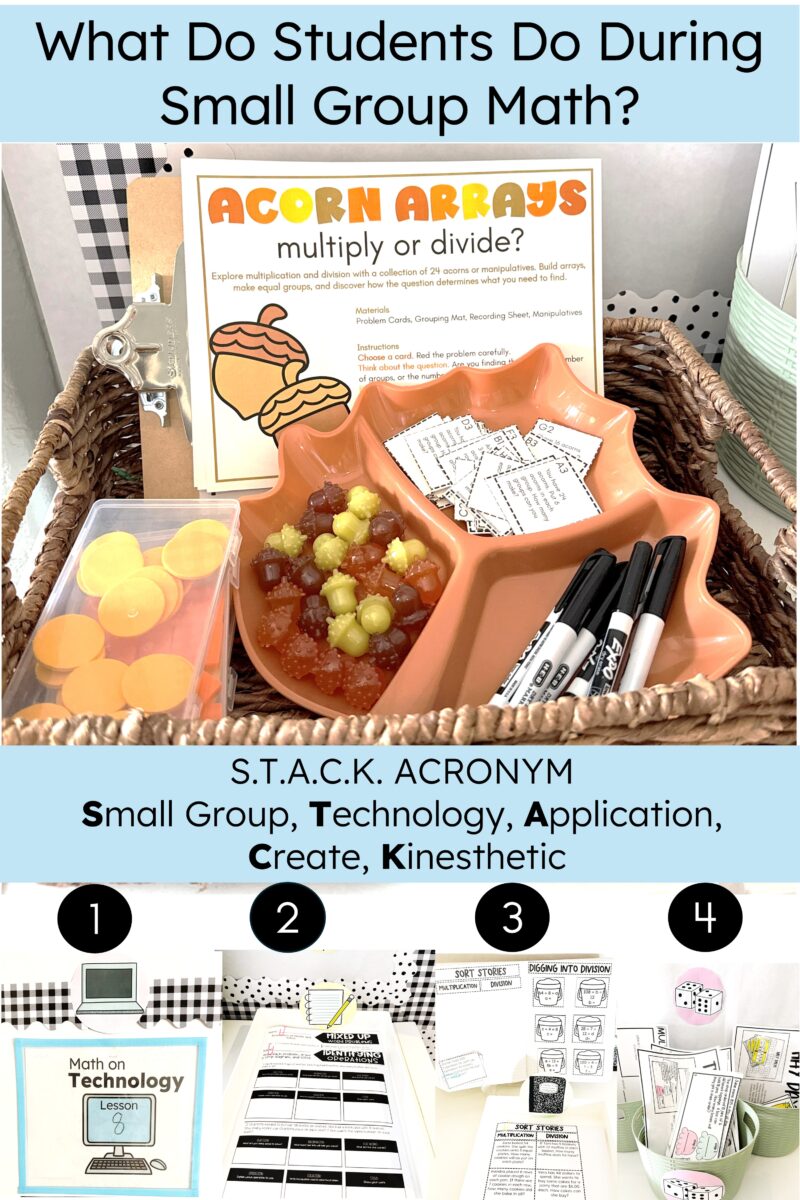
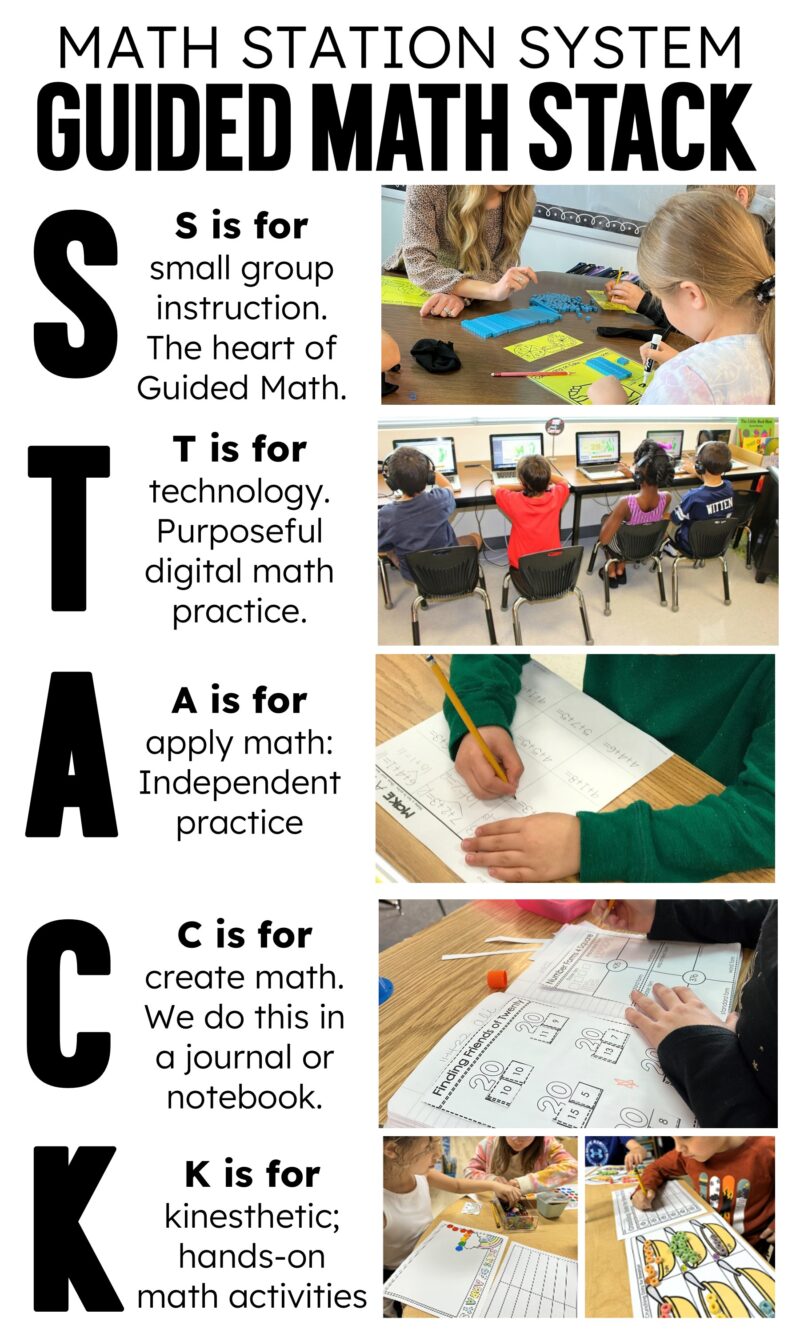
STACK organizes small-group instruction and student practice into five parts: small group and four third grade multiplication and division math stations. It is not necessary to do all five parts to use this system! You can design it anyway that works for your classroom needs.
The station structure stays familiar as the content changes. Students learn where to find materials, what their work should include, and how to put everything away.
The examples below connect multiplication and division across the four math stations. They do not all need to happen on the same day. Introduce the skills and activity directions before assigning independent station work, and keep previously taught activities available for review.
For a more general look at the STACK framework and free icons for setting it up in your own classroom be sure to read Math Stack Workstations Free Download.
Small Group: Third Grade Multiplication and Division with Free Acorn Arrays
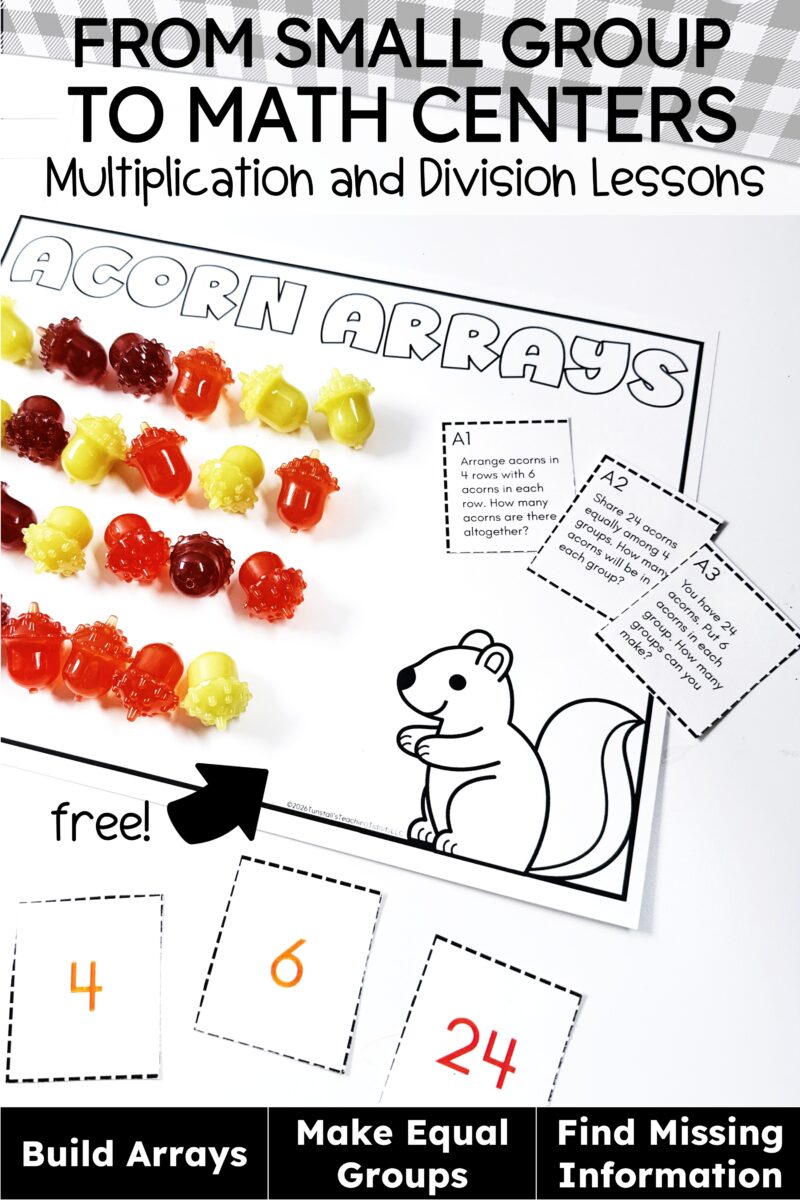
Acorn Arrays gives students a concrete way to explore three questions:
- How many are there altogether?
- How many belong in each group?
- How many groups can we make?
Begin with the related numbers 4, 6, and 24. First, have students build four rows with six acorns in each row. They are finding the total: 4 × 6 = 24. Next, give students 24 acorns to share equally among four groups. They are finding how many belong in each group: 24 ÷ 4 = 6. Finally, ask students to put 24 acorns into groups of six. They are finding the number of groups: 24 ÷ 6 = 4.
Before students write an equation, ask:
“What do you know, and what do you need to find?”
The numbers are related, but the unknown changes. Building each situation gives students something to point to as they explain their thinking.
The free download includes 24 problem cards, mats, a recording sheet, an answer key, related-number cards, and teacher directions. Use acorn counters for a seasonal lesson or substitute counters you already have.
Download the Free Acorn Arrays Activity
Practice multiplication and division with 24 problem cards, hands-on mats, and a recording sheet.
Support Students with More Multiplication and Division Lessons
The free third grade multiplication and division math station activity can help you identify what students need next. Some may need more practice distinguishing between the number of groups and the number in each group. Others may be ready to represent a story with a diagram or work through a problem with more than one step.
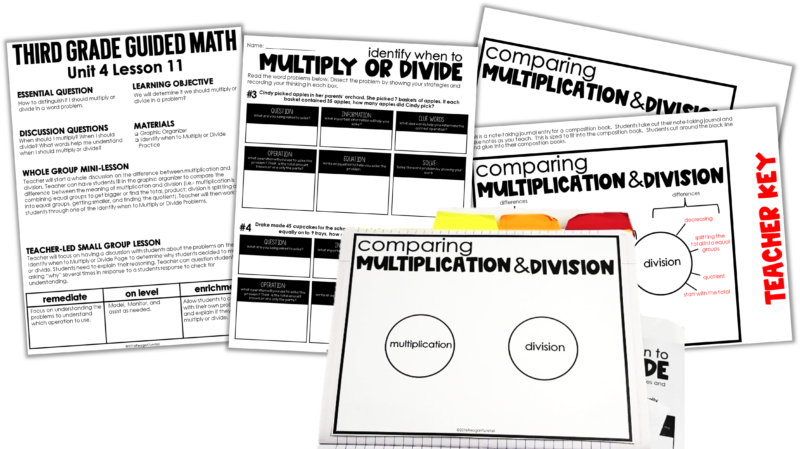
Third Grade Guided Math Unit 4: Multiplication and Division provides planned instruction for continuing this work. This is a previous lesson to the one shown in these third grade multiplication and division math stations.
Technology: Extend the Thinking with Multistep Problems
The Technology station shown here identifies Lesson 8, Multi-Step Laundry. Displaying both the lesson number and activity title gives students a clear reference for their assignment. This third grade multiplication and division math station provides 10 self checking prompts.
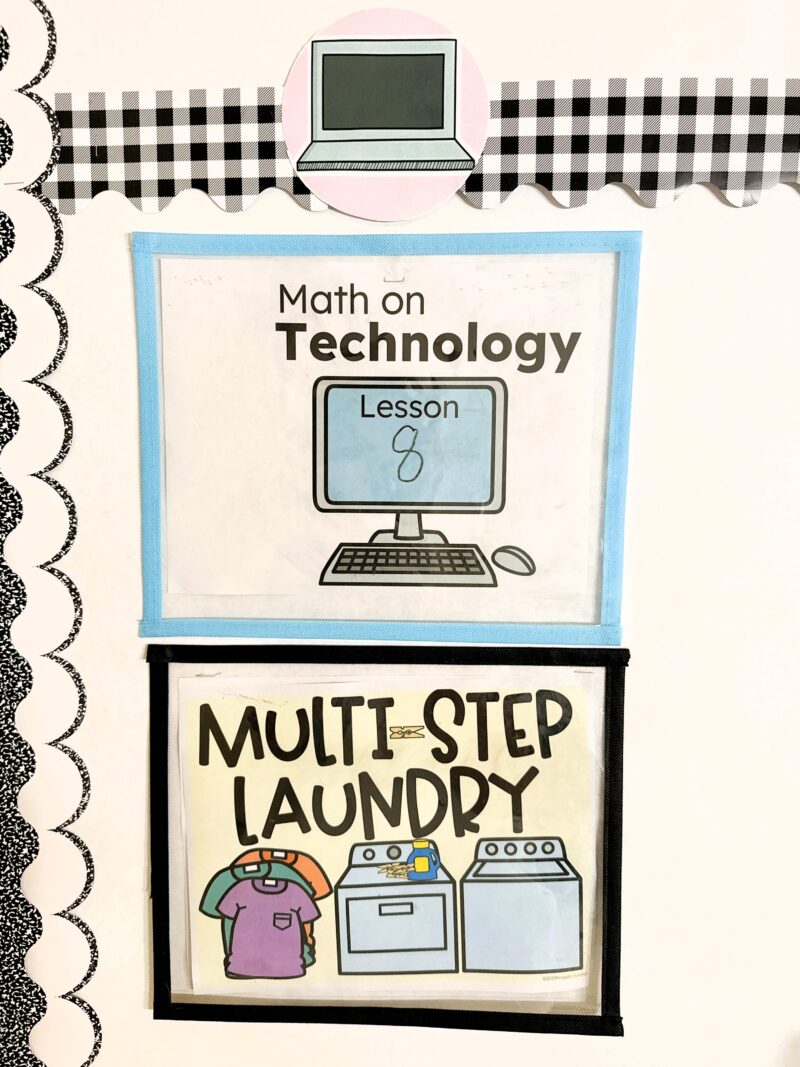
Use Digital Guided Math: Third Grade Multiplication and Division Problem Solving to provide digital practice alongside your instruction.
Before assigning multistep work independently, model how students can pause after the first calculation and ask, “Have I answered the question yet?”
That question carries the small-group discussion into more complex problems. Students need to understand what each answer represents and whether another step is needed.
I recommend showing students how to access the assignment and what to do when they finish before making it part of their independent rotation.
Application Station: Identify the Operation and Show the Thinking
The Application station includes Identifying Operations and Mixed Up Word Problems from the Third Grade Multiplication and Division Problem Solving Skill Pages. This third grade multiplication and division math station is easy to grade and provides independent practice.
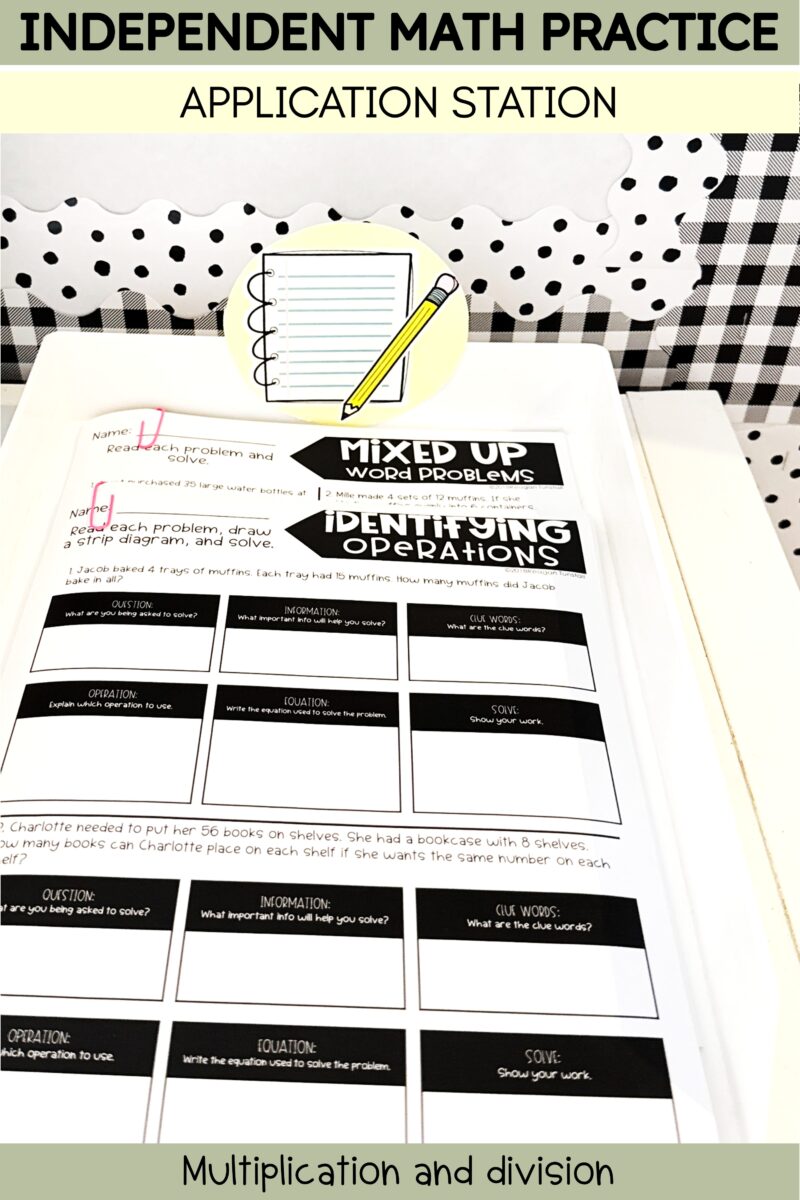
On the Identifying Operations page, students work through the question, relevant information, operation, equation, and solution.
One problem describes four trays with 15 muffins on each tray. Students find the total: 4 × 15 = 60 muffins.
Another describes 56 books shared equally across eight shelves. Students find how many books belong on each shelf: 56 ÷ 8 = 7 books.
These problems revisit the same distinction students explored with the acorns: Are they finding the total or the amount in each group?
When discussing the page’s “clue words” box, have students explain what the language tells them about the quantities. For example, “the same number on each shelf” describes equal groups. Students still need to read the whole situation to decide which quantity is unknown.
Independent work helps you see who can make those connections without a teacher guiding each step. Keep counters or drawing tools available when students need a model.
Create: Sort Stories and Explore Multiplication and Division in Math Journals
At the Create station, students use their math journals to organize and explain their thinking. This is a favorite third grade multiplication and division math station.
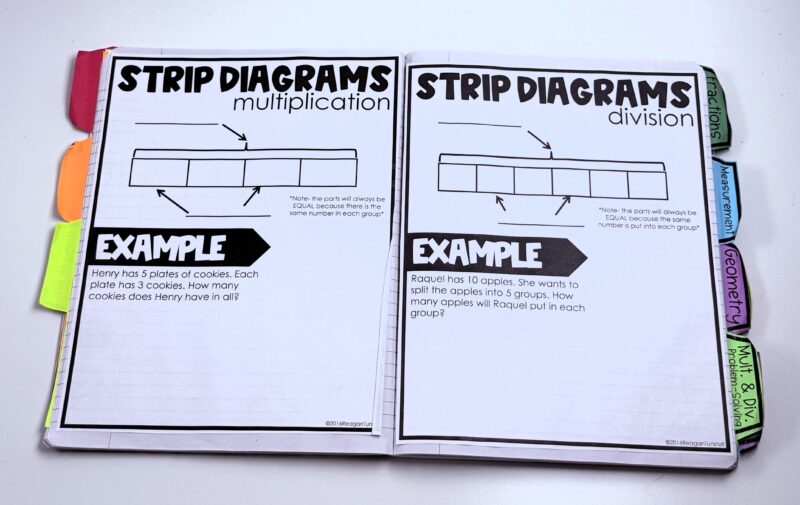
The setup below features Sort Stories and Digging Into Division from Third Grade Math Journal, Volume 4: Multiplication and Division Problem Solving.
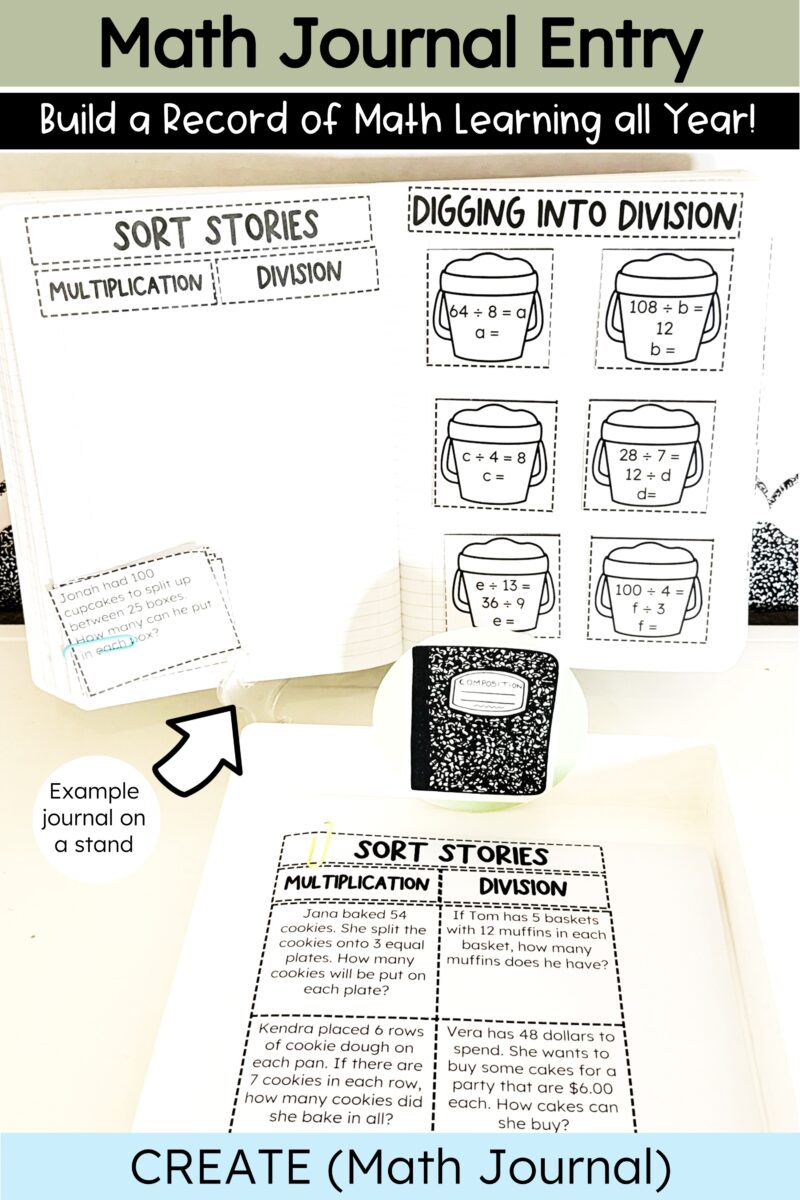
In Sort Stories, students read and sort problems under multiplication or division.
For example, a story about five baskets with 12 muffins in each basket asks students to find the total. A story about 54 cookies shared equally onto three plates asks them to find how many belong on each plate.
After students sort, ask them to choose one story and explain their decision with a drawing or equation.
Digging Into Division extends the work to unknowns in different positions. Students might solve 64 ÷ 8 = a or c ÷ 4 = 8. The second equation gives them a reason to use multiplication to find the missing total.
Introduce the journal task before assigning it independently. An example notebook can show students where the entry goes and how to organize their work without giving away the solutions.
Kinesthetic: Hands-On Multiplication and Division Math Stations
These popular third grade multiplication and division math stations shown come from Stations by Standard: Third Grade Multiplication and Division Problem Solving. Keep the cards, directions, and recording pages together so students have everything they need for independent practice.
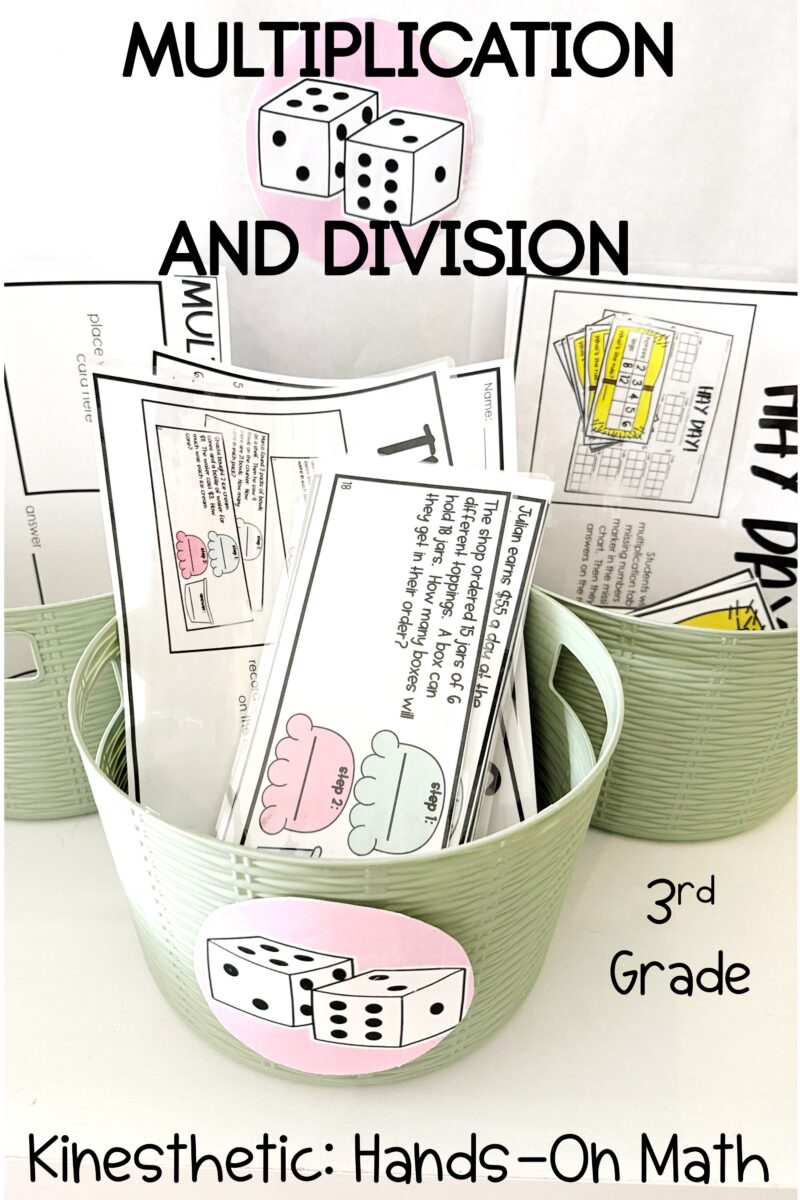
The photographed activities include Hay Day and cards that organize problem solving into two steps.
One card describes a shop ordering 15 jars of each of six toppings, with 10 jars fitting in each box. Students first find the total number of jars:
15 × 6 = 90 jars
Then they find how many boxes are needed:
90 ÷ 10 = 9 boxes
The two-step recording spaces give students a place to separate those decisions. Ask, “What did your first answer tell you? How did you use it in the next step?”
Hay Day provides another practice format through multiplication tables with missing numbers. Students identify the relationship and record the missing values.
Choose an activity students are ready to complete independently. The photo shows several prepared options, but students do not need to complete every tub during one station visit.
Organize Math Stations for Independence
Your setup can answer several questions before students need to interrupt small-group instruction:
- Where do I go? Use the same station icon on the display and materials.
- What am I working on? Display the activity title or lesson number.
- What do I need? Keep cards, recording pages, and tools together.
- Where does my work go? Establish a consistent collection routine.
The trays in this setup keep Application and Math Journal pages easy to find. The sample journal shows the layout, while the Technology display identifies the assignment.
Plan rotations around the time available. Students can visit the stations across more than one day while you meet with small groups.
Build Your Third Grade Math Stations with Guided Math STACK
Acorn Arrays is one starting point. The larger goal is to have instruction and practice ready for the different parts of your math block.
The Third Grade Guided Math STACK bundle brings together resources for teacher-led instruction and student stations across the year.
This multiplication and division setup shows how that can look: students build models with you, apply their understanding on a skill page, sort and explain problems in a journal, and revisit the learning through digital and hands-on activities.
You can begin with an individual component where you need support or explore the full bundle to plan across the STACK framework.
Explore the Third Grade Guided Math STACK Bundle
Build Multiplication and Division Fact Fluency
After building the models, use the related-number cards to connect facts. With 4, 6, and 24, students can write:
4 × 6 = 24 · 6 × 4 = 24 · 24 ÷ 4 = 6 · 24 ÷ 6 = 4
Ask, “How can knowing one fact help you solve the others?”
For ongoing practice, my Multiplication and Division Math Fact Fluency resource includes flashcards, practice pages, booklets, and quizzes for facts through 12. Choose the facts students are working on, build accuracy through regular practice, and use the included checklist to track their progress.
Download the free multiplication and division task cards
Use Acorn Arrays to introduce the routine at your small-group table, revisit a confusing problem type, or give students meaningful practice in a math center.
Start with one set of related problems and listen for this explanation: “I know _____, and I need to find _____.” That explanation helps you see how students connect the story, the model, and the equation.
Download the Free Acorn Arrays Activity
Practice multiplication and division with 24 problem cards, hands-on mats, and a recording sheet.
Never miss a tidbit
Teach More. Plan Less.
Get FREE research-based K-5 resources and fresh classroom and teaching ideas that help you make learning engaging and meaningful for your students!


18 years in the classroom, K-5 math PD presenter, and author of Guided Math AMPED. More about me