

 Contact
Guided Math in First Grade: A Practical Math Workshop Guide
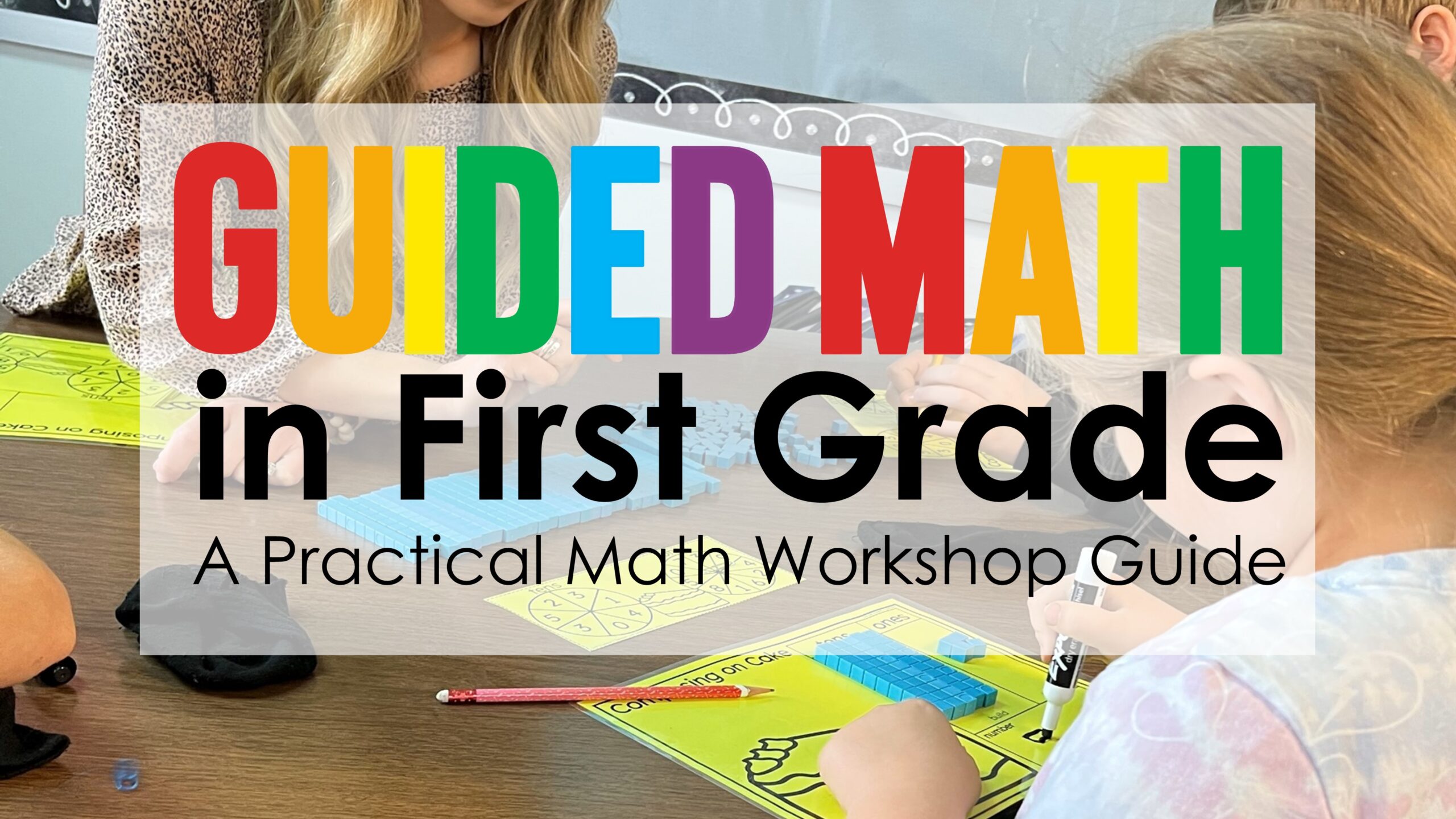
Guided math in first grade creates time for targeted small-group instruction while students work independently on meaningful math tasks. The goal is not to prepare five brand-new centers every week or keep six-year-olds moving constantly. The goal is to create a predictable math workshop in which students know what to do, teachers can respond to student needs, and every part of the block has a clear purpose.
I began sharing my guided math classroom in this original post more than a decade ago. Since then, I have spent years refining the routines, writing the Guided Math AMPED framework, presenting guided math professional development, and creating math workshop resources for teachers in kindergarten through fifth grade. The materials and technology have changed, but the strongest first-grade math blocks still rely on the same essentials: a focused lesson, purposeful small groups, familiar independent routines, and time for students to talk, model, practice, and apply their thinking.
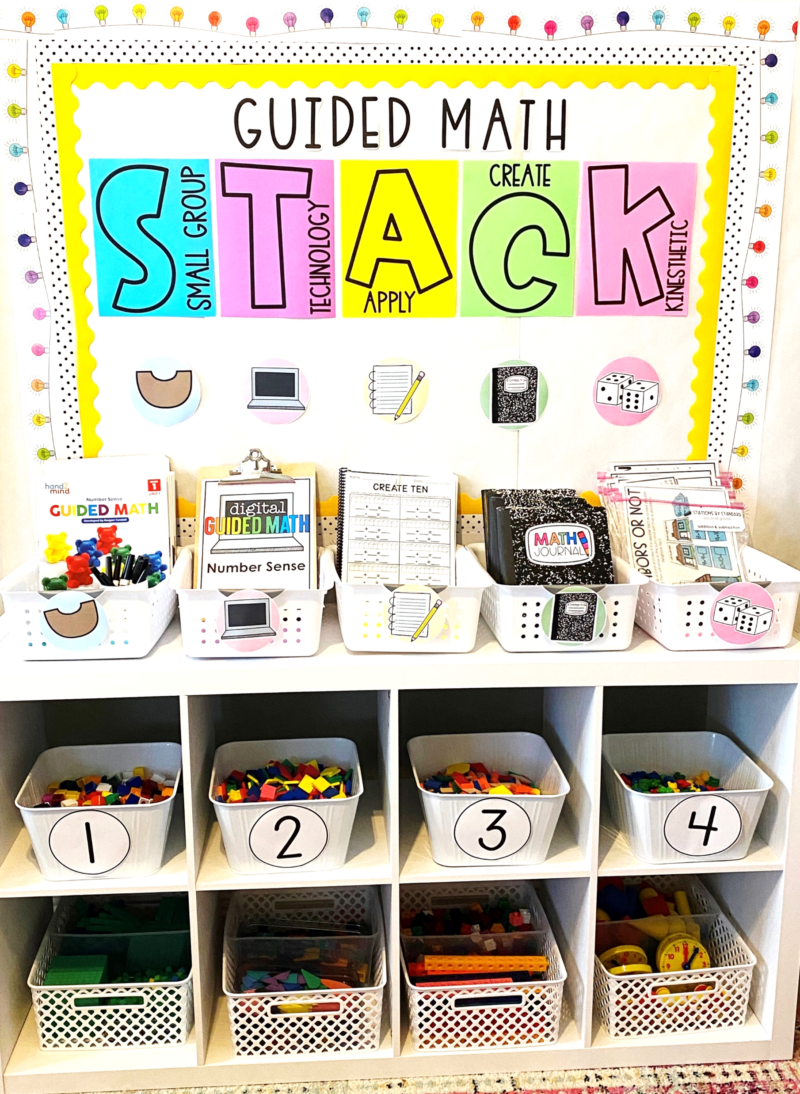
If guided math feels like too many moving pieces, start with the structure. A successful first-grade math workshop can be simple.
Planning a new math workshop? Use the free 20-day Math Workshop Launch Guide to introduce routines, materials, transitions, small groups, and independent stations one step at a time.
What Is Guided Math in First Grade?
Guided math is a flexible way to organize math instruction. It is not a specific curriculum. A typical first-grade guided math block includes a short whole-group lesson, teacher-led small groups, and independent math rotations. This structure makes it possible to teach a grade-level goal while adjusting the models, questions, numbers, and support students receive. The broader practical guide to Guided Math and Math Workshop explains how this framework can be used across K–5 classrooms.
That flexibility matters in first grade. One student may still need counters to solve an addition problem while another is ready to explain two different strategies. Both students can work toward the same mathematical goal without receiving the exact same lesson.
Guided math can work with the curriculum your school requires. The structure organizes teacher-led instruction and meaningful independent practice without requiring teachers to replace the math curriculum already in place. The First Grade Math STACK provides organized workshop rotations for the complete school year.
A Realistic First-Grade Guided Math Schedule
There is no single correct schedule. The best schedule is one that fits the minutes available and can be repeated consistently.
There is no single correct schedule. The best schedule is one that fits the minutes available and can be repeated consistently.
| Math block | Warm-up | Mini-lesson | Rotations and small groups |
|---|---|---|---|
| 60 minutes | 5 minutes | 15 minutes | Four 10-minute rounds |
| 70 minutes | 5 minutes | 15 minutes | Five 10-minute rounds |
| 75 minutes | 5 minutes | 20 minutes | Five 10-minute rounds |
| 90 minutes | 10 minutes | 20 minutes | Four 15-minute rounds |
For additional schedule options, see Guided Math Schedules and Math Rotation Slides and Schedules for Small Group Instruction.
Begin With a Short, Active Mini-Lesson
The whole-group lesson gives everyone access to the day’s mathematical goal. In first grade, ten to fifteen focused minutes is often enough.
A strong mini-lesson may include:
- A clearly stated math goal
- A familiar visual model or manipulative
- Teacher modeling
- Student math talk
- One or two opportunities to try the strategy
- A quick check before rotations begin
The mini-lesson is not the only time students will learn the concept. It introduces or connects the learning so it can be developed through small-group instruction and purposeful practice.
Keep the lesson active. Students can build with cubes, sketch a model on a whiteboard, turn and explain an idea, compare two strategies, or show whether they agree with a solution. The purpose is mathematical thinking—not sitting quietly through a long explanation.
What Happens at the Teacher Table?
Teacher-led small groups are the responsive heart of guided math. This is where a teacher can listen closely, notice misconceptions, change the model, and ask the next question based on what students actually understand.
A first-grade small-group lesson does not need to be complicated. Use a consistent flow:
- Connect: Revisit the math goal or a familiar problem.
- Model: Use concrete materials or a visual representation.
- Practice together: Prompt students to build, draw, solve, and explain.
- Check understanding: Ask each student to demonstrate the thinking independently.
- Respond: Add support, change the numbers, or extend the reasoning.
Whenever possible, move through the concrete–representational–abstract progression. Students first build the idea with manipulatives, then represent it with drawings or models, and finally connect it to numbers and symbols. The pace will not be identical for every group.
Meet with the teacher for targeted small group instruction organized with First Grade Guided Math Lessons. Groups should remain flexible. Regroup according to the concept and the evidence students provide rather than treating a group as a permanent label. to identify needs, form flexible groups, and check progress. Stay organized with the Small Groups Math Teacher Binder.
Read more about planning responsive lessons in Small Group Math Instruction: Best Practices for K–5 Classrooms.
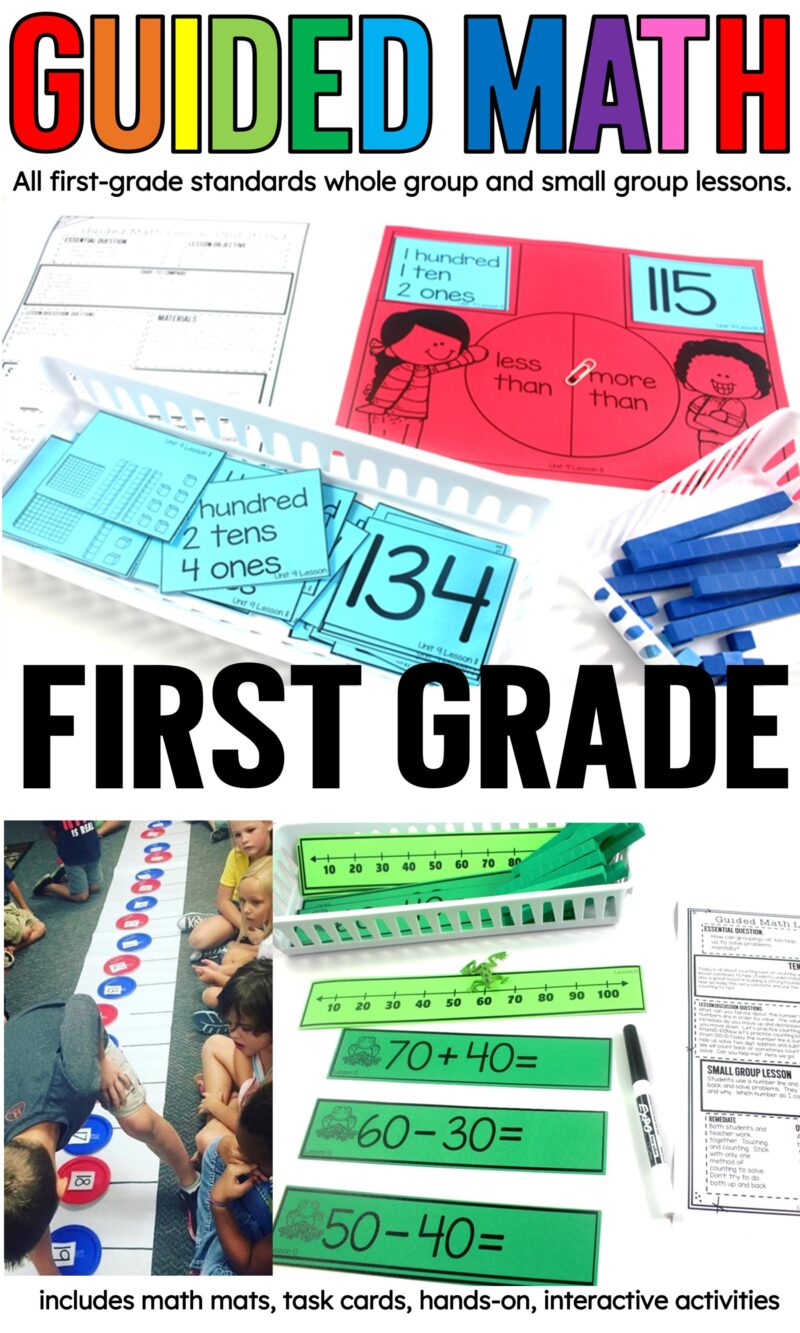
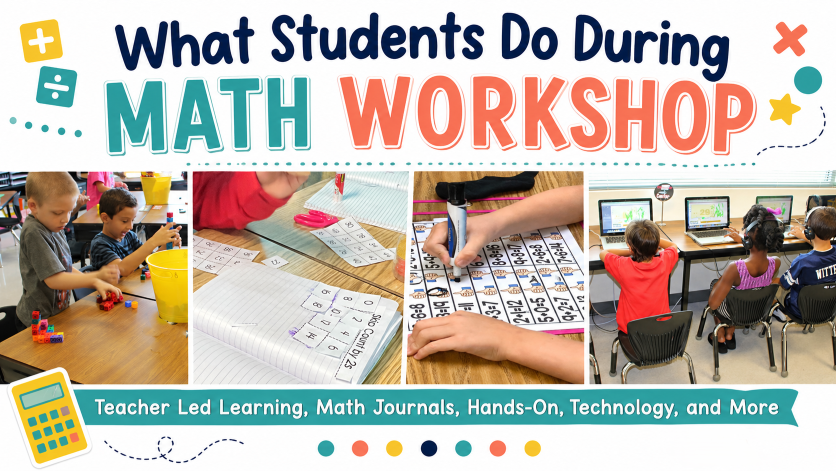
What Do Students Do During First-Grade Math Rotations?
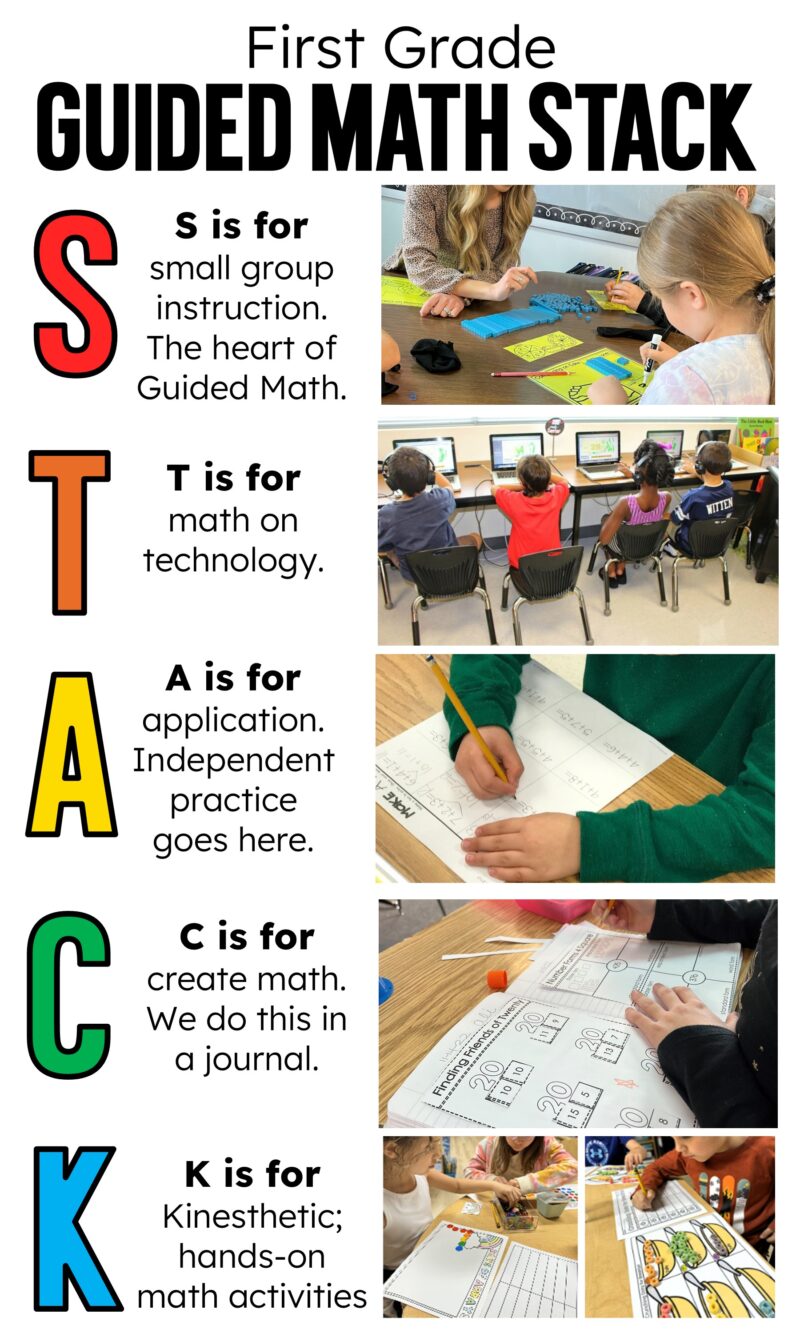
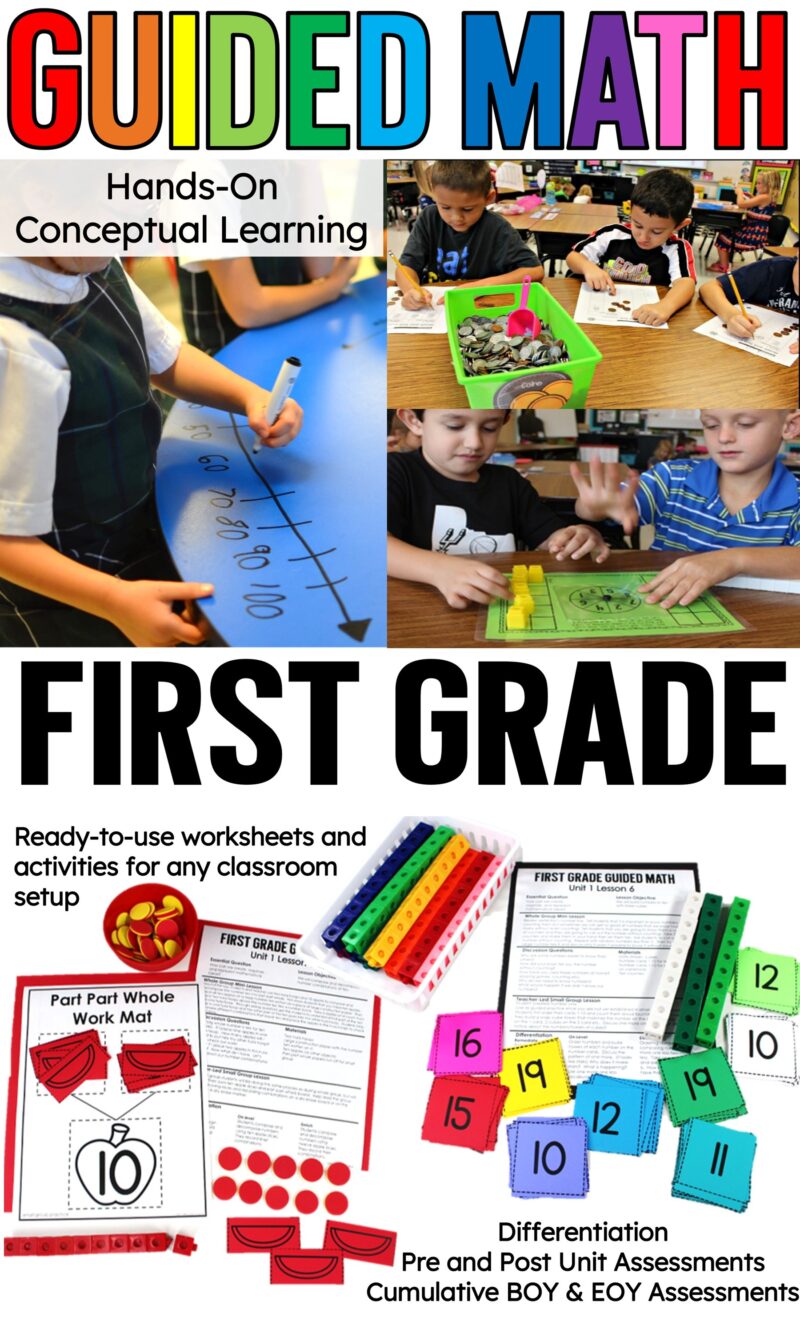
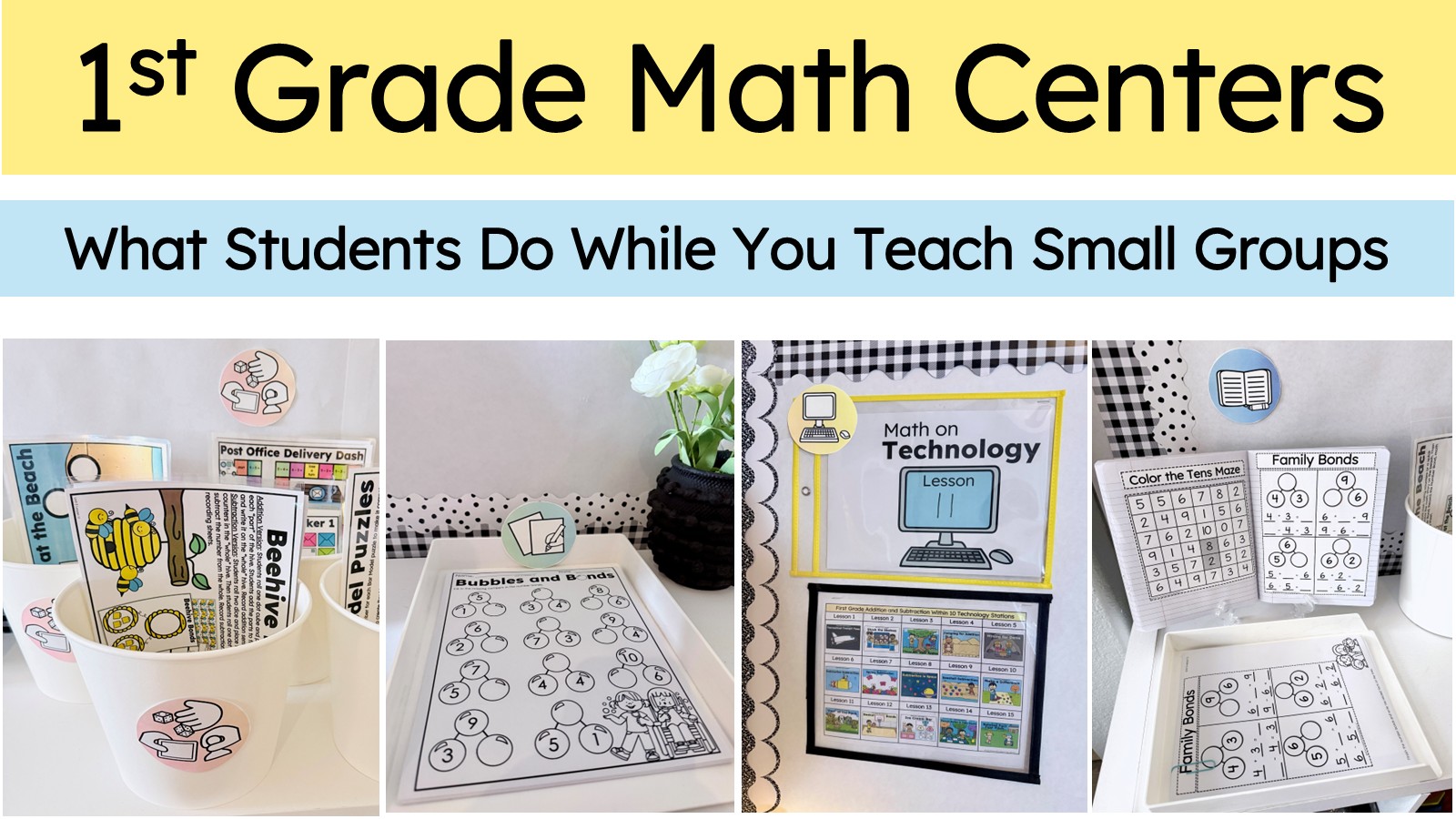
Independent rotations should provide useful practice without requiring constant teacher assistance. I organize the first-grade possibilities through Math STACK:
- S — Small Group: Meet with the teacher for targeted instruction organized with using the First Grade Guided Math Lessons.
- T — Technology: Use the Digital Guided Math for Math on Technology.
- A — Apply: Students independently practice a previously taught skill with First Grade Standards Practice.
- C — Create: Students represent numbers and show their thinking in the included Numbers Notebook. Both a Common Core First Grade Numbers Notebook and a TEKS First Grade Numbers Notebook are available.
- K — Kinesthetic: Students build understanding through hands-on games and First Grade Stations by Standard.
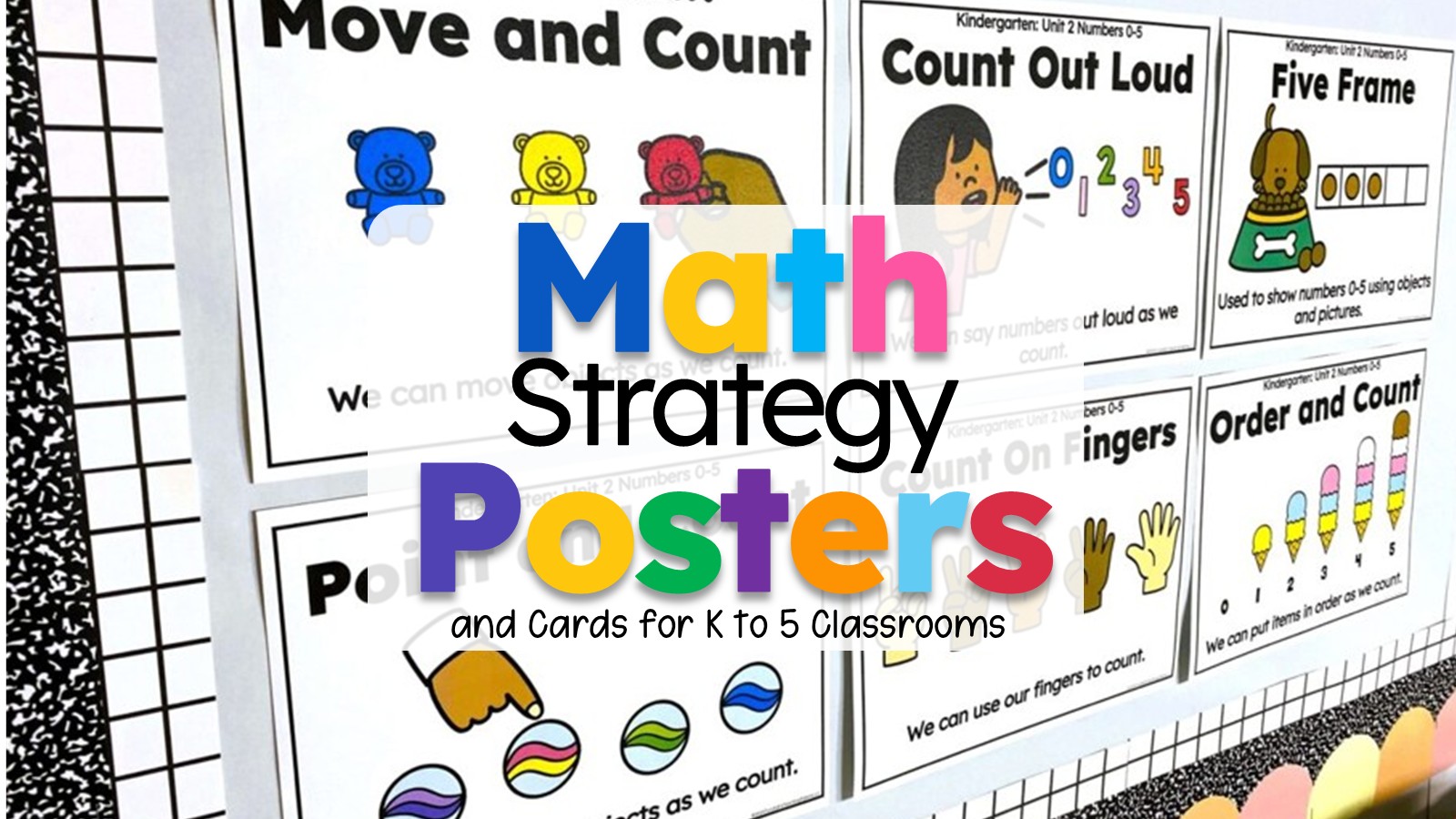
The academic rotations are supported by the Guided Math rotation timers, math vocabulary cards, and math strategy posters. These tools make the language, strategies, expectations, and movement of the workshop visible so students can work more independently.
STACK is flexible. A five-group class can complete all five ten-minute rounds in one day. A class with a shorter block can complete fewer rounds and rotate the remaining components across the week. Either way, the same familiar structure keeps the focus on math rather than new directions.
The independent work should feel familiar even when the math changes. Repeating an activity format allows students to concentrate on the skill instead of learning new directions every Monday.
For a closer look at the rotation options, visit What Students Do During Math Workshop. You can also download free Math STACK workstations to try the structure.
How to Build Independence During Math Centers
Independent first-grade stations do not become independent because the directions are cute or the containers are labeled. Independence is explicitly taught.
Before expecting students to rotate while you teach a small group, model and practice:
- How to get the materials
- Where to work
- How to begin without waiting for the teacher
- What an appropriate voice level sounds like
- What to do when something feels difficult
- What to do when the work is finished
- How to clean up and rotate
- What finished work should show
Introduce one routine at a time. Practice it correctly, model common mistakes, let students identify what needs to change, and repeat the procedure until it becomes predictable. Opening too many stations at once usually creates more interruptions later.
A useful center also has a clear academic purpose. Students should practice a concept that has already been taught, use materials they understand, and produce something that lets the teacher see their thinking. Hands-on does not have to mean unaccountable.
Find more specific support in How to Foster Independence During Math Stations.
Choosing First-Grade Math Center Activities
The strongest math centers combine consistency with worthwhile mathematics. Instead of changing every part of a station, keep the format familiar and change the numbers, representations, or skill.
First-grade centers might ask students to:
- Build and compare numbers
- Represent tens and ones
- Practice addition and subtraction strategies
- Sort or compose shapes
- Measure and compare objects
- Organize and interpret data
- Solve story problems
- Practice fact fluency through meaningful games
Before placing an activity in an independent rotation, ask:
- Have students already learned the underlying concept?
- Can they understand the directions without interrupting the teacher table?
- Does the activity require mathematical thinking rather than busywork?
- Is there a recording, model, conversation, or product that shows what they understand?
- Can the same structure be reused with another skill?
Consistency lowers the management load for the teacher and the cognitive load for students. The new thinking should come from the mathematics, not from constantly changing procedures.
For a closer look at the full range of station choices, visit Resources for Math Workstations K–5. The examples span grade levels, but the management principles—clear expectations, familiar formats, and purposeful practice—are especially helpful when planning first-grade rotations.
Using the Numbers Notebook and Math Journals
Within the First Grade Math STACK, the Numbers Notebook is the included Create component. It gives students a consistent place to represent numbers, record equations, draw models, and show their mathematical thinking. Teachers can choose the version aligned to their standards: Common Core Numbers Notebook or TEKS Numbers Notebook.
First-grade written responses do not need to be long. A student might draw two ways to make ten, label a number representation, solve a story problem, or complete the sentence, “I know this because…” The goal is to make mathematical thinking visible.
Teach notebook routines just as carefully as center routines. Students need to know where notebooks are stored, how to find the correct page, which tools they may use, and what finished work looks like.
Teachers who want a separate spiral-review journal can also explore Getting Started With Math Journals and the First Grade Math Journal Year Bundle. The Math Journal is an additional option; the Numbers Notebook is the Create resource included in First Grade Math STACK.
Differentiate Without Planning Three Completely Different Lessons
Differentiation does not require separate topics for every group. Keep the mathematical goal connected and adjust the access point.
Try changing:
- The number range
- The manipulative or model
- The amount of teacher prompting
- The number of examples
- The type of recording required
- The complexity of the question
- The expectation for explanation or proof
For example, all groups might work on addition strategies. One group builds each problem with counters and draws the action. Another uses a ten frame to explain making ten. A third compares two strategies and decides which is more efficient. The goal remains connected while the support and reasoning change.
See Five Methods of Differentiation During Math Stations for additional ways to adjust grouping, station choices, materials, strategies, and levels of support.
What If the Math Block Is Short?
Guided math can still work in a shorter block. Protect the parts that have the greatest instructional value:
- Keep the mini-lesson focused.
- Use two rotations instead of forcing every station into one day.
- Meet with targeted groups rather than every group daily.
- Rotate groups across the week.
- Use familiar independent formats.
- Place reflection or an exit problem at the end of the final rotation.
A forty-five-minute block might include a ten-minute mini-lesson, two fifteen-minute rotations, and a five-minute reflection. On the following day, different students meet with the teacher. The structure should serve instruction; the schedule does not need to serve the acronym.
First-Grade Guided Math Resources
The best resource path depends on what is already in place.
I need organized first-grade rotations that work with my curriculum.
The First Grade Guided Math STACK Bundle brings the Guided Math components into one familiar yearlong system. It includes Stations by Standard, Numbers Notebook, digital math warm-ups, rotation timers, the small-group math binder, standards practice, guided math assessments, math vocabulary cards, and math strategy visuals. Teachers can use the components with the curriculum already required by their school.
This is the established Guided Math and Math STACK resource line. The product links in this section stay within that resource line.
My students need a visual rotation system.
Run your math workshop rotations easily with customizable Guided Math Timers in Google Slides and PowerPoint. Build your math small group rotation with timers to create an organized and simple way to manage math workstations. Students learn the consistent routine and understand their role within the system.The Guided Math Rotation Board includes editable group labels, station cards, and rotation displays.
I want to see the complete Guided Math resource library.
Use the Guided Math Resource Compilation to browse warm-ups, whole-group teaching, small-group instruction, workstations, journals, technology, application, intervention, home connections, professional development, and grade-level resources. You can also explore the Guided Math and Workstation Resources collection.
Frequently Asked Questions About Guided Math in First Grade
How many guided math groups should I have in first grade?
Three to five groups usually provide enough flexibility without making the rotation system unnecessarily complicated. The number depends on class size, instructional needs, and the length of the math block.
Do I have to meet with every group every day?
No. Meet with the groups that need the most direct instruction for the current concept and rotate the schedule across the week. Frequency should respond to student need.
How long should a first-grade math rotation last?
Ten-minute rotations work well for first graders when the task format and transition routine are familiar. Begin with one or two stations while procedures are developing, then build toward the full five-round schedule.
Can guided math work with my required curriculum?
Yes. Guided math is an instructional structure. Use the lessons and materials required by the school, then organize targeted small-group instruction and purposeful independent practice around them.
Do students need to visit every STACK station every day?
Not necessarily. In a five-group, five-round schedule, students can visit all five STACK stations in one day. With a shorter block, select the stations that fit the math goal and rotate the remaining experiences across the week.
Start With the Routines
The most effective first-grade guided math block is not the one with the greatest number of activities. It is the one students understand.
Begin with one routine. Model it, practice it, and repeat it. Add the next part only when students can manage the first. Once the structure becomes predictable, the teacher gains the freedom to listen closely, respond to student thinking, and make small-group instruction count.
Use the free 20-day Math Workshop Launch Guide to introduce the complete process step by step.
This is seriously amazing! I love all the pictures and ideas! Thanks!! 🙂
Kristen
A Day in First Grade
I absolutely love your ideas. Can’t wait to try them with my kiddos!
Thank you so much Reagan! This post was exactly what I needed! Thank you for taking the time to answer my questions! You are AMAZING! I appreciate this soooooo much! I cannot wait to start revamping my math block – I feel like I can maybe do some Guided Math now! Thank you again!
I love doing math centers! My math centers are very similar. We have workbook pages in our math book that is one center. I also have 18 students so we only do 4 centers: teacher, math tubs, workbook pages, and computers. I have started using math journals in my math warmup and want to incorporate them in centers too as my students become more independent. What do you use for math journals? Do you have a product in your store? I see many math journal prompts that are great but too hard for some of students to read.
Thanks!
I love this! It is very similar to how I do my guided math, so it gives me good ideas on how to tweak it. JEALOUS of all your technology!! I have one computer and no IPads/Pods so my class is sorely lacking in opportunities to use technology. 🙁 One of the things they do instead is work on their math fluency. They have sand timers they use to time themselves doing addition and/or subtraction facts. When they are done they graph how many problems they were able to finish and they move up through different levels. They LOVE beating levels- they think it is like a video game! Thanks for taking the time to share this!
This is a great explanation of your day. I am assuming you do not use a curriculum like enVision. What do you use as a pacing guide? (My district is just starting to transition to Common Core. Any pointers or suggestions to ease the transition would be appreciated!)
I so want to do this.
Except I do not have technology and I want yours.
And I have 30 students with two open spots that can be filled at a moment's notice.
I am going to do this.
I must.
I have started math centers and so appreciate your ideas, this will help me do a better job for math time. I also wanted to say how much I LOVE the rise and shine binders, that has been a wonderful addition to my morning. Thanks for sharing your wonderful teaching strategies.
Jill
This is great Reagan! Thanks for sharing. How long does your math time last?
Grade ONEderful
Ruby Slippers Blog Designs
I'm having an easy giveaway at Grade ONEderful. Hope you stop by:)
An hour and 10 minutes…give or take!!! 🙂
What do you do with the kids who finish their worksheet quickly during their station? I have some who fly through it and do perfectly fine.
Thankyou for your "crazy long post"! It's fabulous to have this level of detail.
Thanks for sharing all these great ideas! It is so hard to find time to get it all done and teach the standards- and I have to stay on pace with my teammates. (We have to give the same assessment tests…) Using your *Rise and Shine* binders this year has really helped!!
Love this post no matter how crazy long!! This gives some great ideas and inspirations! I wish I could come down to Texas and observe your amazingness!!
This is awesome. As a relative n00b to 1st grade, it is so helpful to have things explained thoroughly (and with pictures!) This is a great idea that I can see really working in my classroom too! Thank you so much for posting things like this. 🙂
Thank you so much for this great post on your math centers! This is something I've struggled to "get right" for years. I've tried different ways, but so far, I haven't been thrilled. I have always wanted to integrate math journals into my block, but I have never figured out how! Thank you so much for sharing how you use math journals in your class! I wish I had iPads in my room to use for math time. Our school has some, but I think it would be frowned upon if I took 6 of them and kept them all year. 🙁 I love the idea of students getting on iPads during this time, though! This was a great post- thank you!
Erica
Blooming In First
Hi-
Great ideas!! Do you sell any of your math journal activities?
Hi Reagan,
I loved this post a lot. It will help me get my Math stations going and I love that it can be differentiated. Being in a new school, we are still waiting for our Ipads and we have no computers so I will have to adjust that one for now. I would also like to know how long your Math block is for.
Shelley
The Perks of Teaching Primary
An hour and 10 minutes—give or take! 🙂
I have many of your products in your TPT store and I am also wondering if your journal prompts that are pictured are available in your store. I just purchased the Nutty set and am laminating it as I type. Thanks for sharing all your fabulous ideas!
I always love seeing what you are doing in your classroom! It's always perfect!
Love this idea. Do you guys have to use a core curriculum?
We have a scope and sequence that is based on our standards. Our math adoption was old so we weren't relying on it at all.
What an amazing post! Thanks for your amazing ideas!
How long are each of your small groups? Does each group meet with you each day?
Thanks for the post! Can you explain how you do journals a bit more? I started doing journal time before going to stations but I have many students that take FOREVER in their journals and never get to stations! How do you do journal time as a station/incorporate independent practice with centers ?
Hi Reagan!
I am so happy I found this! These ideas will really help in my classroom! I was wondering if you had to get special permission to photograph your students? I love the pictures!! I would like to add more pictures with my students but I wasn't sure if I could? Thank you for your awesome ideas!
This is just what I needed to pull all the thoughts in my head together!! I Chavez been wanting to do this but was just not sure how!!
Thank you for taking the time to do this!
I sure wish I had that much technology! Does it all belong to your school? Is any of it your own personal technology? I have 2 very old computers and an iPad for my students. I have my teacher desktop which I'm thinking about letting the students use during math.
Wow, Reagan! I love this! It is very organized and I love the variety. I bet your kids love it! Thanks for sharing so many details. That was so helpful!
I love how you run guided math. I began to do it at the beginning of the year but it became too overwhelming for me and the students. Quite frankly, I just didn't know how to run it smoothly. I am trying it again and using this post as my springboard!! Thanks for explaining it all so well!
Jessica
Trading is the Best Business Ever in the World.. All News updates about Forex Business, Latest Currency news updates, latest forex trading business updates, trading updates, forex trading latest news, forex brokers directory, forex brokers list, Dollars news affairs, Stock Markets, stock market news, stock market analysis, technology news, international forex markets, international forex business news and all updates about Forex Trading
ForexAffairs.Com
I love how you run guided math. I began to do it at the beginning of the year but it became too overwhelming for me and the students .I so want to do this.
Except I do not have technology and I want yours.
And I have 30 students with two open spots that can be filled at a moment's notice.
I am going to do this.
I must.
Genuines Works of Data Entry, Copy Pasting, Add Posting, Clicking, Web Surfing, Website Visiting, Article Sharing, Data Sharing, Google Business Plan and Much More Business Plans
http://www.jobzcorner.com
Top Ten Classified Website List, Pakistani Classified Sites, USA Classifieds, Indian Classifieds, Entertainment Articles, Entertainment News, Entertainment Pictures, Bollywood, Hollywood and Lollywood Pictures and Videos, Entertainment Latest updates, Hot Entertainment News and Pictures Funny Entertainment Pictures, lol Pictures, Funny Pictures and every thing you want…
http://www.hotcurrentaffairs.com
Thank you so much for this!!! I only wish I saw this earlier, but now to put it in action!
All Latest and Current Affairs, News updates about Forex Business. Latest Currency news updates, latest forex trading business updates, trading updates, forex trading latest news, forex brokers directory, forex brokers list, Dollars news affairs, Stock Markets, stock market news, stock market analysis, technology news, international forex markets, international forex business news and all updates about Forex Trading
ForexAffairs.Com
Make Money Online is very easy now, In Internet system we have now best earning system without any work, Just Invest some Money into your Business and Make Perfect Life time Earnings with this Business.
Join Now for Make Perfect Business and Earn Money online from home.
http://www.hotfxearnings.com
I am not sure how I missed this post originally but I was very happy to find it today. I have pinned it and will be using it as my model. You are awesome!
Make Money Online is very easy now, In Internet system we have now best earning system without any work, Just Invest some Money into your Business and Make Perfect Life time Earnings with this Business.
Join Now for Make Perfect Business and Earn Money online from home.
http://www.hotfxearnings.com
Your blog very informative. Being a school teacher these blogs really help me out
Latest cars and vehicles, Latest Mazda Models, Racing Cars, International Sport Cars, Concept Cars, PS-Pod, Strange Vehicles, Nissan, Royce Corniche, Ford Concept Cars, Strange Vehicles, Mercedes and More Sport Cars and Vehicles with Pictures and Info
WorldLatestVehicles.blogspot.com
I appreciate you and I would like to read your next post. Thanks for sharing this useful information.
when you start a business then at first you need every business related news. we find a real news that help for your business.
forex business news, financial news, forex factory news, forex trading
Photoshop Fail Peoples in this Network… Fail Prank Peoples, Fail Videos, Fail Pictures, Troll Images, Prank Peoples, Funny Peoples, funny planet, funny facts, funny cartoons, funny movies pics, iphone funny, funny jokes, Prank Images, Fail Pictures, Epic Pictures, Lols and Gags, Lol Pictures, Funny Pictures, Lol is the Laugh out of Laugh where you can Fun Unlimited and Laughing Unlimited.
lolsgag.com
Want to Earn Money on Facebook…?? Now 1st time ever in Internet World, Facebook Sharing Program has been Launch, Just Post a Picture on Facebook and Get $0.07 per Post, Unlimited Postings and Unlimited Earning.
http://www.JobzCorner.com
We Hold our Tutors to a Higher Standard, and Pay our Tutors More Fairly, than nearly any other Tutoring Company.Thus, we have Better (and more Experienced) Tutors.We accept only the top tutor applicants, and will never compromise our selectivity in order to artificially inflate our ranks. In addition, every member of the Team is required to have recently scored in the 95th percentile or above on any standardized test that he/she teaches.Math Tutor Austin, Math Tutor Atlanta, Math Tutor Houston, Math Tutor Seattle.
Math Tutor Las Vegas | Tutor for kids Las Vegas | Math Tutor Charlotte | Math Tutor Phoenix | Math Tutor Hawaii | Math Tutor Los Angeles | Math Tutor Boston | Math Tutor New York | Math Tutor Denver | Math Tutor Chicago | Math Tutor | Science Tutor Las Vegas |
Funny Facts on this Website, Every thing will be funny Troll Images, Prank Peoples, Funny Peoples, funny planet, funny facts, funny cartoons, funny movies pics, iphone funny, funny jokes, Prank Images, Fail Pictures, Epic Pictures, Lols and Gags
LolsGag.Blogspot.Com
Thank you so much!!! Will do my best to do justice to your ideas. This is exactly What I need to see. I wish a great and wonderful teaching life. If only you had been around 20 years ago!
Genuines Works of Data Entry, Copy Pasting, Facebook Posting, Add Posting, Link Posting, Clicking, Web Surfing, Website Visiting, Article Sharing, Data Sharing, Google Business Plan and Much More Business Plans.
http://www.onlinecornerz.ocm
Nice Pics, It looks how Children are enjoying their Classroom session. Also Its very good idea to improve their Mathematical Skills
Math Tutoring Center
What a thorough explanation of how to incorporate guided math lessons along with math stations daily. You make it look so easy! I loved all of your pictures with the detailed explanations. I plan to purchase your monthly math stations with the included ideas for journals along with your math resources with the Essential Questions and Big Ideas. I also love how your room is arranged with all of your math manipulatives labeled and organized in one "math area" in your room. Please continue to create and share with us.
Just wanted to thank you so much for sharing this!
hello! Will you tell us more about how you do your math journals? Do you have a TPT bundle that you use? I would love your feedback on how you incorporate this into your math block! Thanks!
Yes I do have a year's worth of math journals. The links are in this post.
Thank you so much for the guidance. I have been trying to figure out how to change my math block to something more like this. This will help a lot. Keep sharing. We don't mind reading long posts when they are helpful. 🙂
WOW ~ impressive!! I am changing to first grade and will definitely be using your ideas on the math stations. Thank you so much!! I am going to look through your other stuff!!
Thank you for sharing how you setup your guided math. This is something I wanted to work on this summer to implement next year. This post is very helpful. Now I want to purchase all your math activities!! 🙂
where did you get the flag pennant banner that says MATH?
and your chalkboard alphabet posters?
Sooo glad I found this!! I totally needed to re-vamp my math centers from last year. We just never got in the groove last year. Thanks so much for all of the step by step direction and the freebie!! 🙂
Много благодаря!Brawo!
When you do your groups, do all kids do all centers every day?
In finding a Maths tutor, some factors can be considered to ensure your child has the best. Read here for more details: Maths Tutor Melbourne.
How do your kids work through the math tubs? One a day or when they are done playing the game they go to the next tub?
How do you ability group your students at the beginning of the year? Do you administer a certain test?
I am in love with all of your math material and you classroom layout! I was wondering where you got the great Ipad cases? I have 6 Ipads in my classroom and I am always using them but I always fear my students are going to drop them!
How are the apply centers different from the tub centers?
…I don't know what to say… This is absolutely amazing! It is getting near the end of the school year for us in Australia and the gears are up and running for next year. I will have to bookmark this page until I find out my new year level for 2015 (here's hoping for Grade 1!)
Thank you so much for taking the time to go through all of this. It is seriously amazing!
Miss Gibson's First Grade Fun
I love doing math centers! My math centers are very similar. We have workbook pages in our math book that is one center. I also have 18 students so we only do 4 centers: teacher, math tubs, workbook pages, and computers. I have started using math journals in my math warmup and want to incorporate them in centers too as my students become more independent. What do you use for math journals? Do you have a product in your store? I see many math journal prompts that are great but too hard for some of students to read.
Thanks!
I love your math material it is awesome!! How did you group your students? Do you give a certain test? I also had a question about your math tubs. How do your kids work through them? once or twice a day?
Thanks!
I love this! It is very similar to how I do my guided math, so it gives me good ideas on how to tweak it. JEALOUS of all your technology!! I have three computers that work and no IPads/Pods so my class is sorely lacking in opportunities to use technology. 🙁 One of the things they do instead is work on their math fluency. They have sand timers they use to time themselves doing addition and/or subtraction facts. When they are done they graph how many problems they were able to finish and they move up through different levels. They LOVE beating levels- they think it is like a video game! Thanks for taking the time to share this!
By the way, did you purchase your own technology or did your school provide them? I would love for my class to have IPads or IPods
.
That noise level is my issue now and I can't get to math groups to save my life. The year is almost over but I plan to go this route next year. Maybe these last couple of weeks as well. Its a start. We already have math tubs, and computer. I do journal but I can make that a part of the rotation schedule.
Can I just say you amaze me, and I can't wait to try all of this! Thank you for all of the wonderful tips!!
I love this! Thank you so much for sharing! I'm definitely going to try this for the upcoming school year! I have one question, what kind of things do you have the students doing for their "Apply" rotation?
You are using great tip for teaching mathematics, by doing so students will not get bored. Moreover, it helps in making the strong base of Mathematics which is very important. Only a professional maths tutor can do this.
I love all your center/tubs. I am looking for these type of centers for grade 4 /5. Do you have any for upper grade materials can you recommend someone else? Thank you!
Hi! I really love this post and every thing about your math block. I would love to purchase your journals as well:) I could just be tired from chasing first graders all day LOL but could you explain again how the kids transition from journals to tubs? Is it timed or do they go individually to a tub when they're done with the journal work? Thank you!
Have you developed a list of manipulatives that you recommend having for Guided Math? If not, do you know where I could find one. Our school is trying to get a Guided Math program together.
i love what you have completed here. keep up the great writing!
How many copies of each center activity do you put in each of the 5 tubs. I have 19 kids in my class.
these practical activities really groom the child mind. we appreciate these practicals, and as a teaching website we also need to focus on practical things.