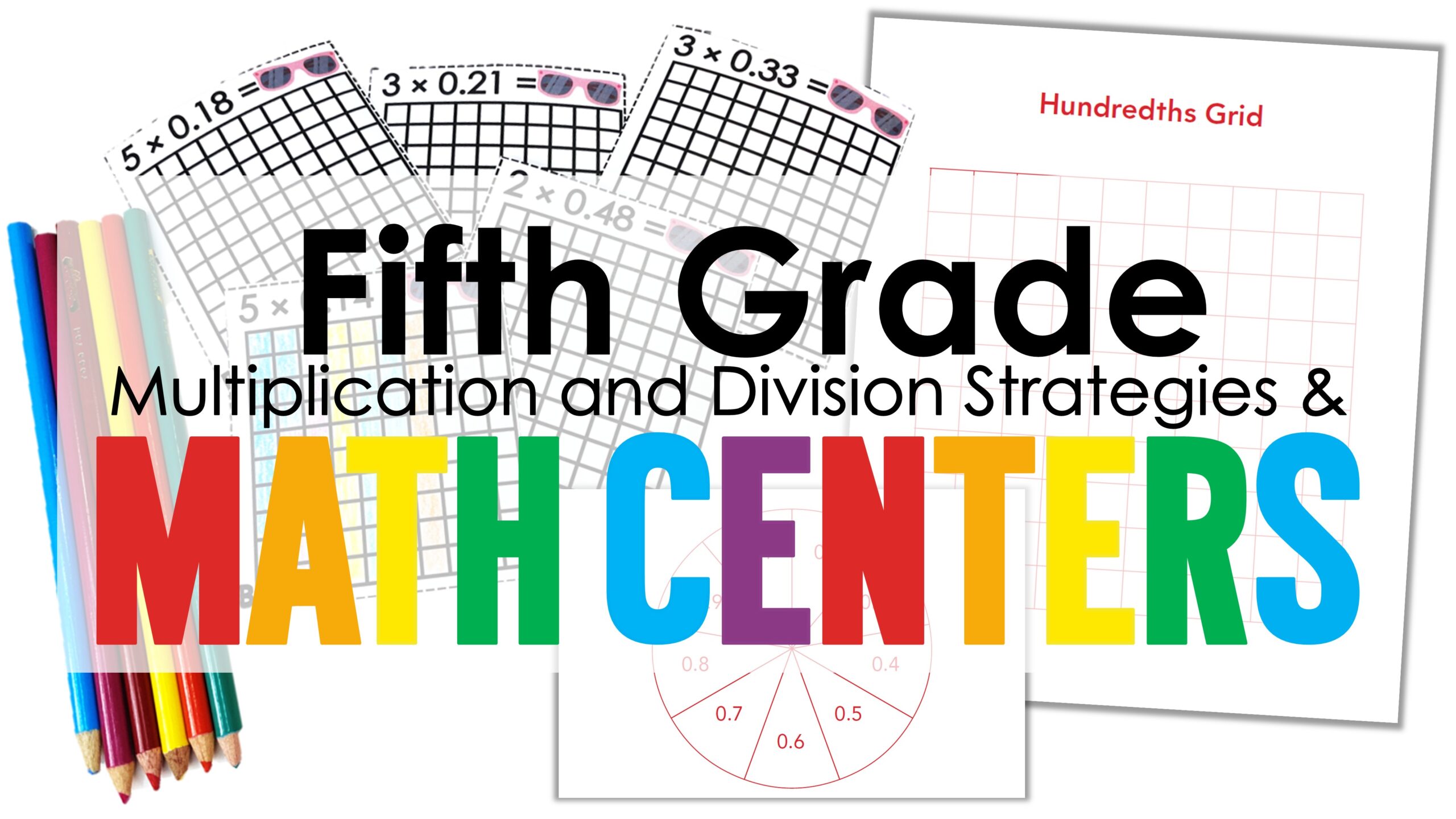
Fifth Grade Multiplication and Division Strategies, Models, and Math Centers
Fifth grade multiplication and division bring together so many important mathematical ideas. Students work with larger numbers, decimal operations, multi-step problems, and strategies that require more than simply following a procedure. One of the most helpful ways to teach these skills is to connect visual models with written methods. Area models, place-value representations, partial products, and partial quotients give students ways to see what is happening in the computation. In this post, I’m sharing fifth-grade multiplication and division strategies, along with teaching examples, math centers, and two free activities you can use with your students.
Teaching Fifth Grade Multiplication and Division with Visual Models
When students begin multiplying decimals, I want them to think about the value of the numbers before worrying about where the decimal point belongs in the answer. Visual models make those relationships clear. Students represent the factors, examine the size of the product, and connect their models to the written equations.
Multiplying Tenths by Whole Numbers
A helpful starting point is multiplying tenths by a whole number. For example, with 0.4 × 3, students can represent four tenths three times using hundredths grids. When the groups are combined, students see twelve tenths, or 1.2. This reinforces repeated addition and helps students understand why the product is greater than one. Instead of treating decimal multiplication as an entirely new operation, students are extending multiplication ideas they already know.
Multiplying Decimals with Hundredths Grids
Hundredths grids are especially useful when students begin multiplying tenths by tenths. Consider 0.4 × 0.3. Students first shade four tenths in one direction and three tenths in the other direction. The overlapping region contains twelve hundredths, representing a product of 0.12.
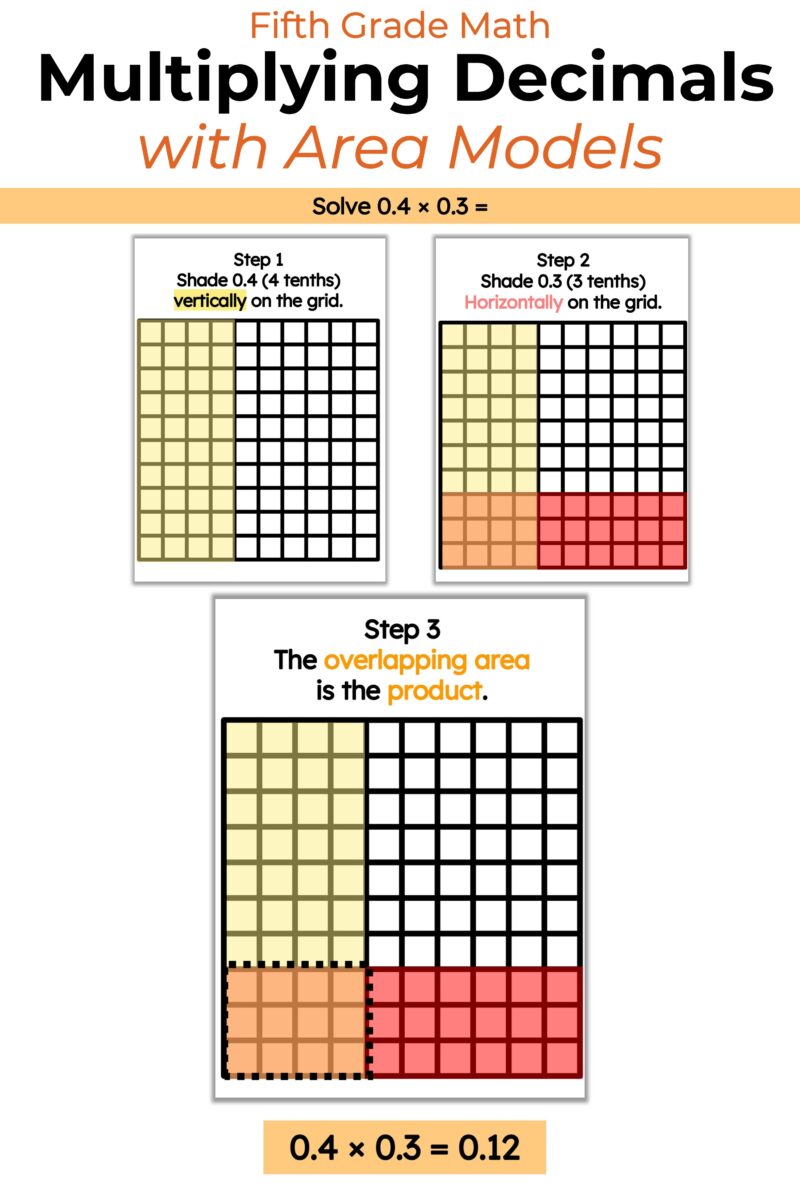 Multiplying decimals with hundredths grids connects the factors to the size of the product.
The overlapping area gives students a visual explanation for why the product is smaller than either factor in this example. I also like using questions that encourage students to explain the model. What does each shaded region represent? Why is the product measured in hundredths? How can we estimate whether our answer is reasonable?
Multiplying Decimals with Area Models and Partial Products
Area models help students multiply larger decimal numbers by decomposing the factors into place-value parts. For example, 2.4 × 3.5 can be represented as (2 + 0.4) × (3 + 0.5). The four partial products are 6, 1.2, 1, and 0.2. Combining those parts gives a product of 8.4.
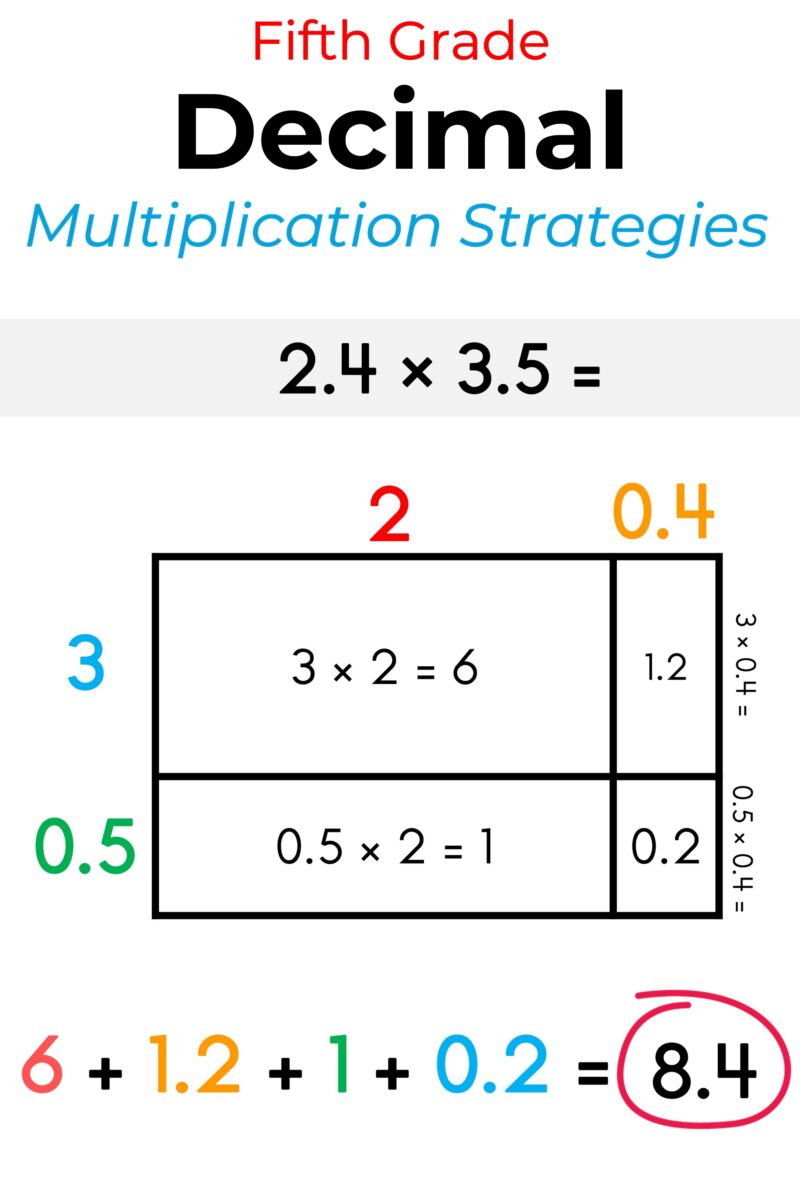 An area model makes the partial products and their relationship to place value visible.
I like that students can see where each partial product comes from. Instead of completing disconnected steps, they are using place value and the distributive property to make sense of multiplication.
Connecting Models to the Standard Algorithm
After using visual representations, students can connect what they know to the standard multiplication algorithm. Consider 0.29 × 0.8 = 0.232. The computation can be performed using whole-number multiplication, but understanding decimal place value is essential to interpreting the answer. Estimation is an important part of this transition. Since 0.29 is close to 0.3, multiplying by 0.8 should give a product close to 0.24. An answer of 2.32 or 0.0232 would not be reasonable. Using models, estimation, and algorithms together helps students check their answers and explain the mathematics behind their procedures.
Free Fifth Grade Decimal Multiplication Lesson
For a closer look at this approach, I have a free fifth-grade Guided Math multiplication lesson you can download. This sample comes from Guided Math Unit 2, Lesson 13 and focuses on multiplying tenths by tenths. The lesson includes instructional guidance, tenths spinner cards, and a hundredths grid. Students use the spinners to select decimal factors and represent the products with visual models.
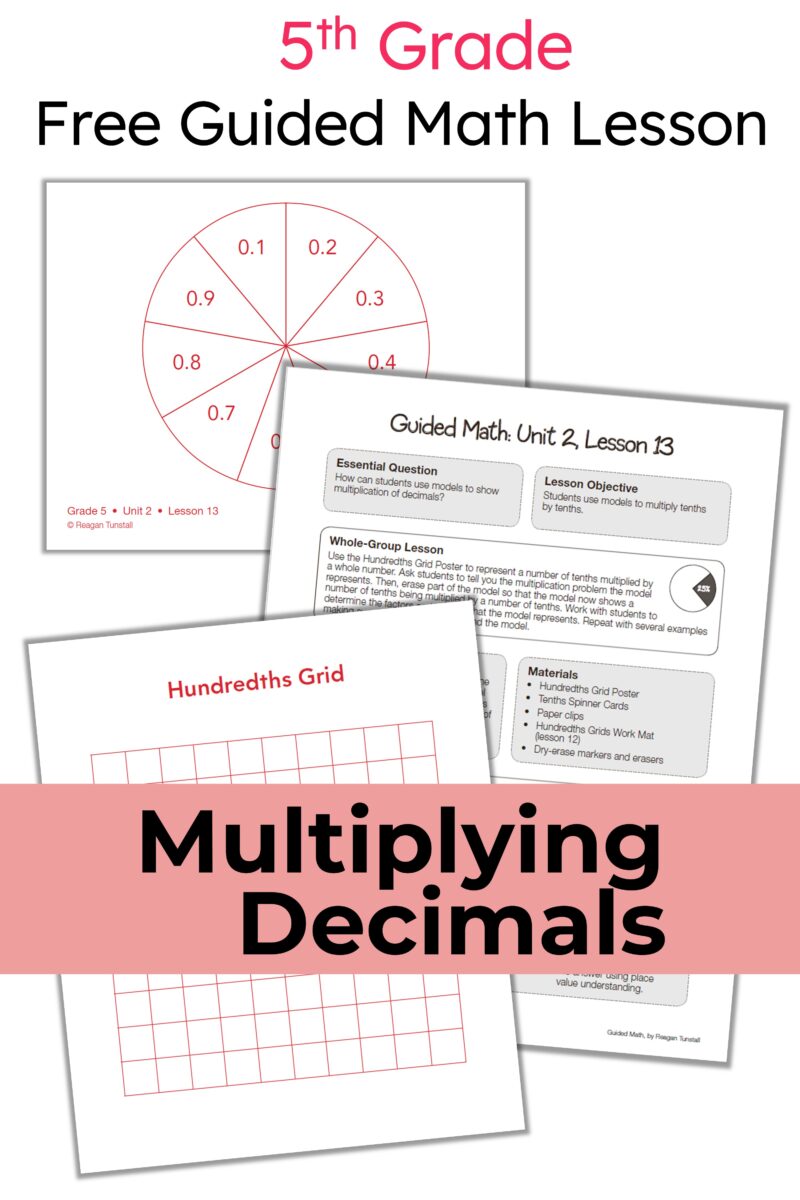
Free Fifth Grade Multiplication Lesson
Download a Guided Math lesson with tenths spinners,
hundredths grids, and instructional guidance
for modeling decimal multiplication.
The complete Fifth Grade Guided Math Multiplication Unit 2 provides additional lessons and instructional materials for teaching multiplication throughout the unit.
Fifth Grade Multiplication Math Centers
Once students have explored a strategy during instruction, math centers provide opportunities to apply those ideas independently. The Fifth Grade Stations by Standard Multiplication Math Centers include activities that use visual models, task cards, sorting, and games to practice multiplication skills.
Decimal Multiplication Models
In the decimal multiplication model activities, students work with hundredths-grid task cards and recording sheets. They can connect shaded models to multiplication expressions and use the representation to determine the product. This gives students continued practice with the visual strategies introduced during instruction.
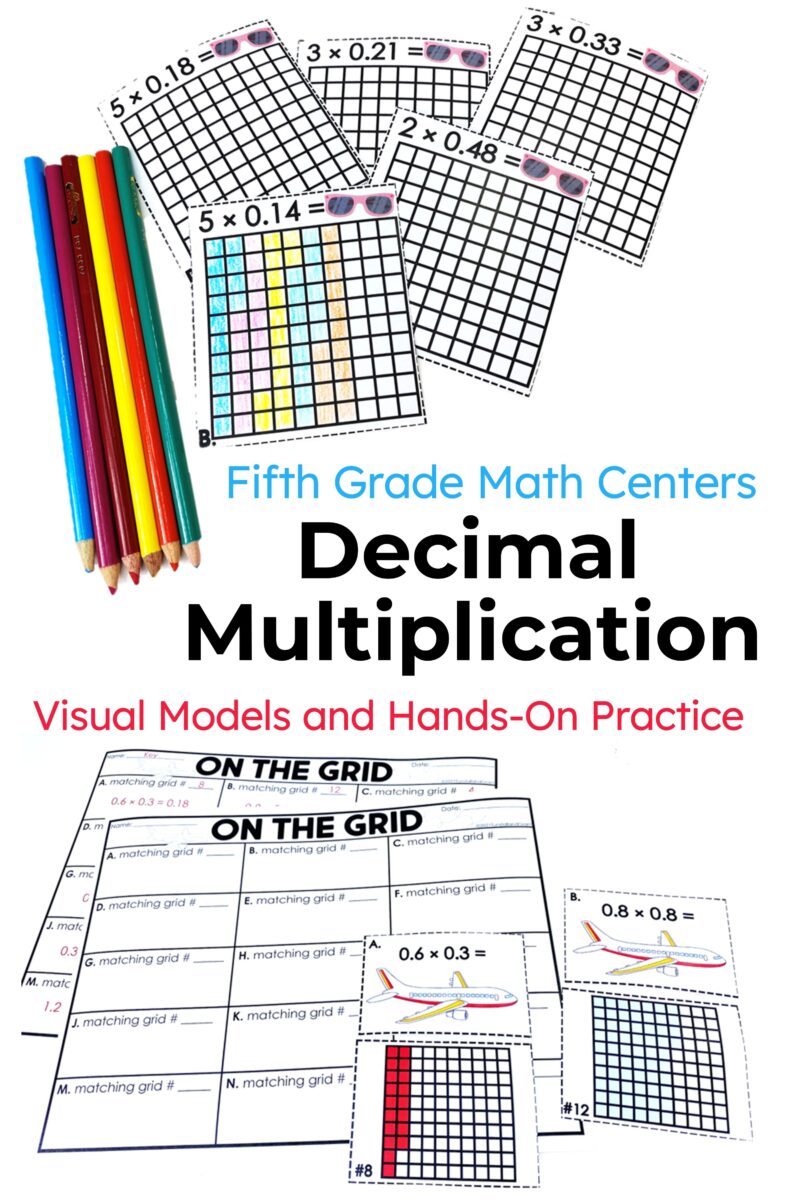 Decimal multiplication models provide a connection between the teacher-led lesson and independent practice.
Multiplication Games and Task Cards
Other centers give students different ways to practice multiplication. Candy-themed multiplication cards, clip activities, and area-model tasks provide variety without changing the underlying mathematics. Students still need to calculate, reason about place value, and determine whether their answers make sense.
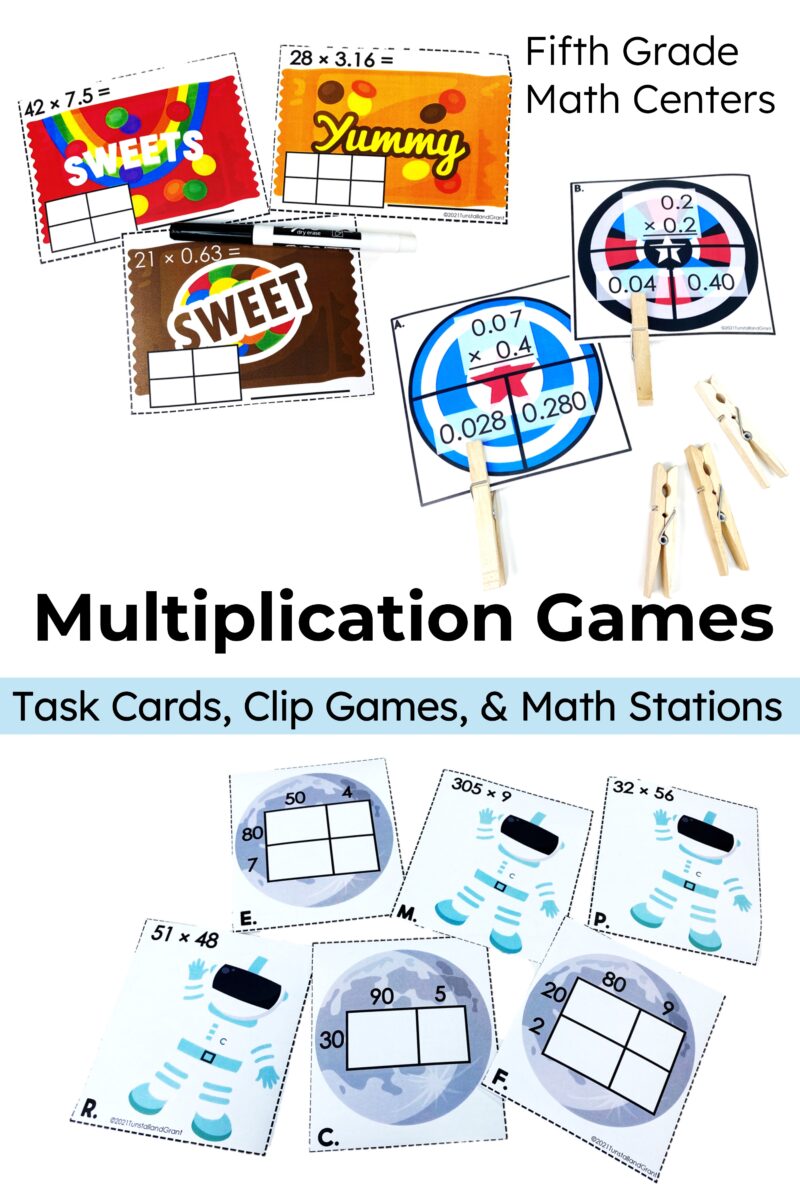 Multiplication centers offer different activity formats for continued practice.
These activities can be used during math workshop, partner practice, or review. I like being able to select a station based on the skill students need to revisit.
See the Fifth Grade Multiplication Math Centers.
Teaching Fifth Grade Division with Models and Strategies
Division becomes more complex in fifth grade as students work with larger dividends, two-digit divisors, and decimal quotients. Visual representations help students connect multiplication, subtraction, and place value to division while building increasingly efficient computational methods.
Estimating Quotients with Compatible Numbers
Before students begin a lengthy division problem, I like having them think about the size of the quotient. For example, with 252 ÷ 6, students might use the nearby compatible number 240 ÷ 6 = 40 to estimate the quotient. They can then determine that the exact answer, 42, is reasonable. Estimation helps students recognize when a calculated quotient is too large or too small, and gives them a useful way to check their work.
Division with Partial Quotients and Area Models
Partial quotients help students break a larger division problem into manageable parts. Consider 3,168 ÷ 24. Students can use familiar multiples of 24 to divide the amount into smaller pieces. First, 24 × 100 = 2,400, leaving 768. Next, 24 × 30 = 720, leaving 48. Finally, 24 × 2 = 48. The partial quotients are 100, 30, and 2. Adding these gives a quotient of 132.
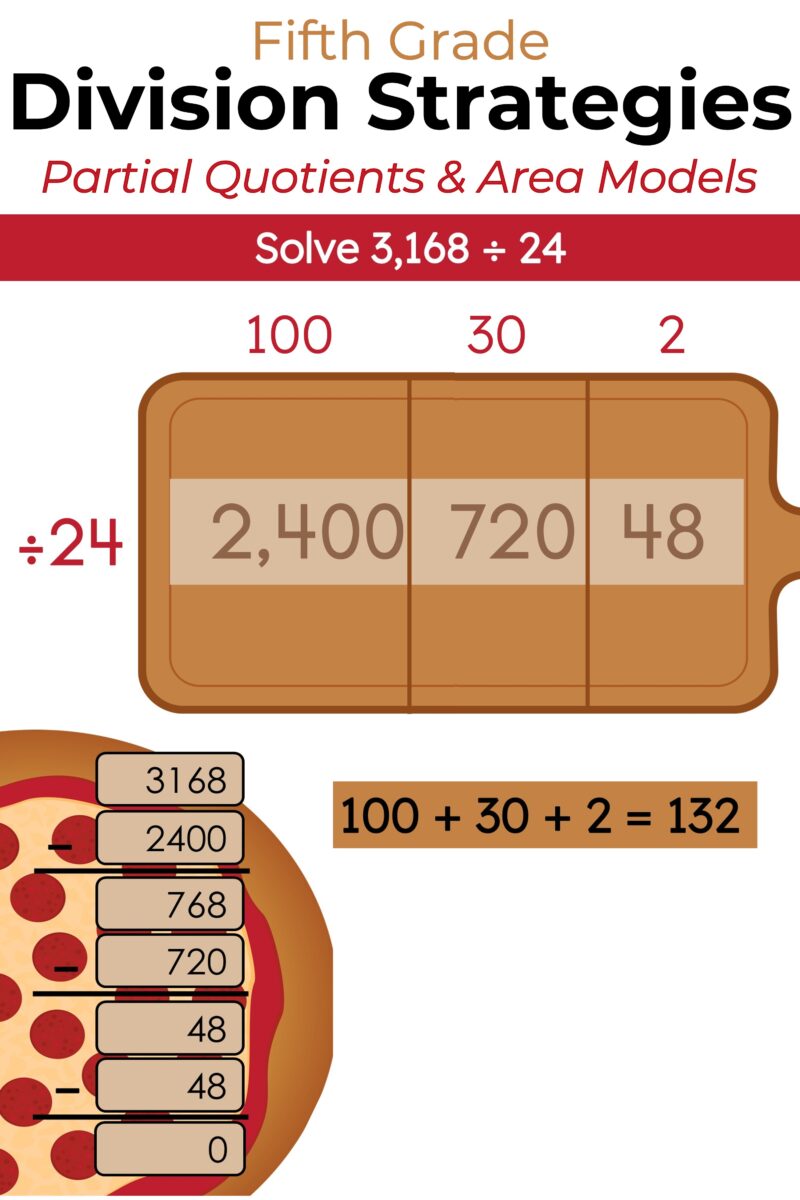 Partial quotients connect multiplication, subtraction, and area models to the division process.
The model shows students why the final quotient is the sum of the smaller quotients. It also gives them a way to connect what they know about partial products to division.
Modeling Decimal Division with Hundredths Grids
Decimal division can also be represented using place-value models. For example, 0.54 ÷ 3 = 0.18. Begin with 54 hundredths and divide them into three equal groups. Each group contains 18 hundredths.
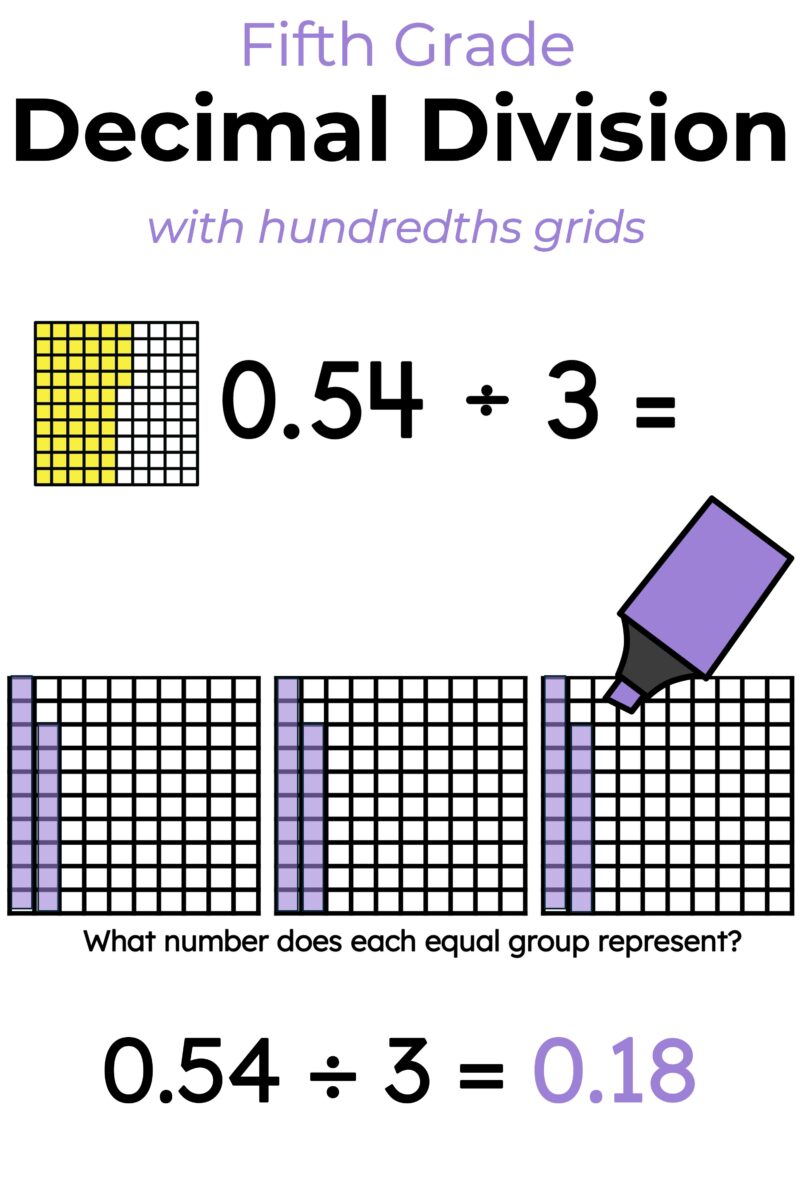 Hundredths grids help students connect decimal division to equal groups.
Students can explain their answers using the model before moving toward more abstract procedures. As the division problems become more complex, this earlier work with place value provides an important connection.
Fifth Grade Division Math Centers and Games
After working through division strategies together, students need opportunities to apply them independently. The Stations by Standard Fifth Grade Division Math Centers provide a variety of activities for practicing division, analyzing models, and recording solutions.
Division Models and Written Methods
One way to extend the instruction is with division grids and task cards that help students organize the computation. In Division in the Desert, students use structured division grids and recording sheets. The activity provides another way to practice the written methods introduced during lessons.
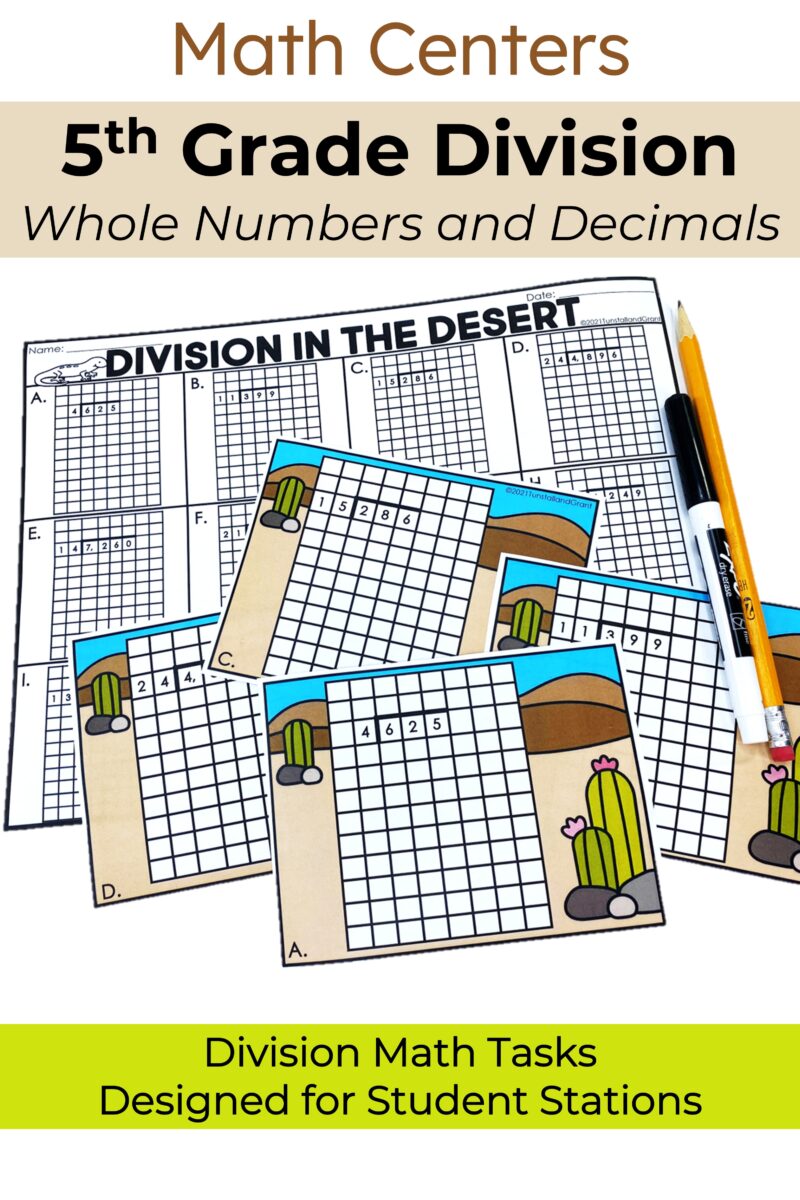 Division in the Desert provides structured practice with division problems.
Other available activities use area models, division games, and tasks that ask students to evaluate quotients and explain their reasoning.
Dividing Decimals with Math Centers
Decimal division centers provide additional opportunities to practice place-value relationships. Students can work through division equations, match representations, or solve problems while recording their answers.
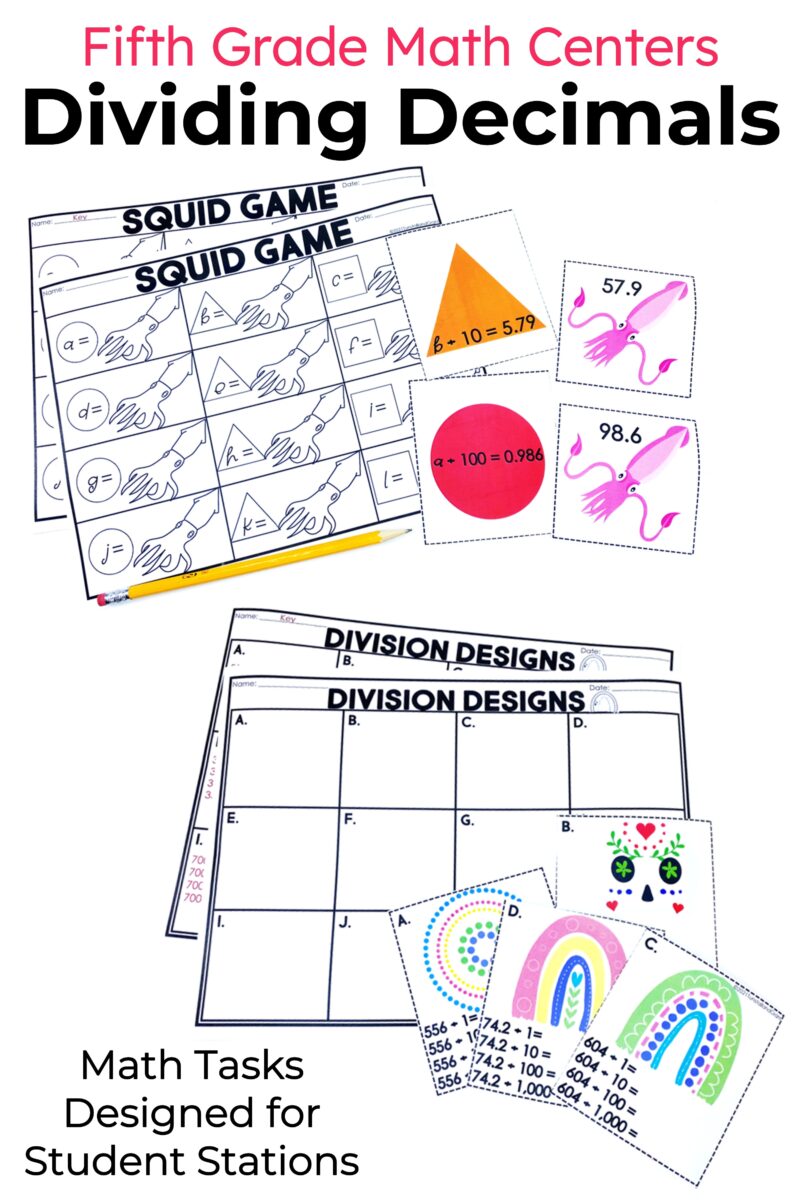 Decimal division task cards offer additional independent math station practice.
For more division activities, explore the Fifth Grade Division Math Centers, Multi-Digit and Decimal Games Collection.
Free Fifth Grade Decimal Division Math Center: True or False?
I also have a free decimal division center you can use right away. In Decimal Division True or False?, students read a division equation, solve it, and determine whether the quotient shown is correct. When the statement is false, students write the correct quotient on the recording sheet. The download includes 12 task cards, a student recording sheet, and an answer key.
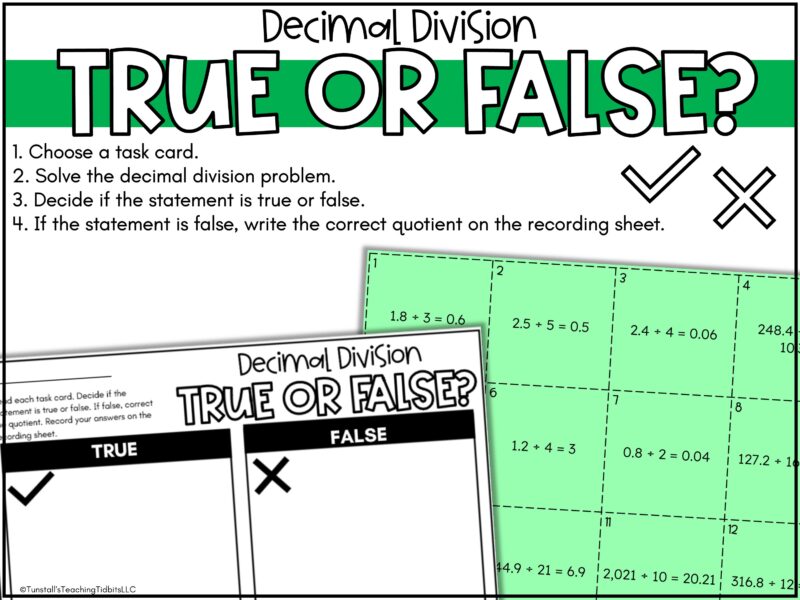
I like this format because students do more than compute an answer. They must also determine whether the quotient makes sense and identify errors. This activity can be used as an independent station, partner activity, or review task.
Free Fifth Grade Decimal Division Center
Download Decimal Division True or False
with 12 task cards, a recording sheet,
and an answer key.
Using Math Journals for Fifth Grade Multiplication and Division
Math Journals provide another way for students to record and revisit their mathematical thinking. Students can practice estimating products, multiplying and dividing decimals, solving word problems, and recording the strategies they use.
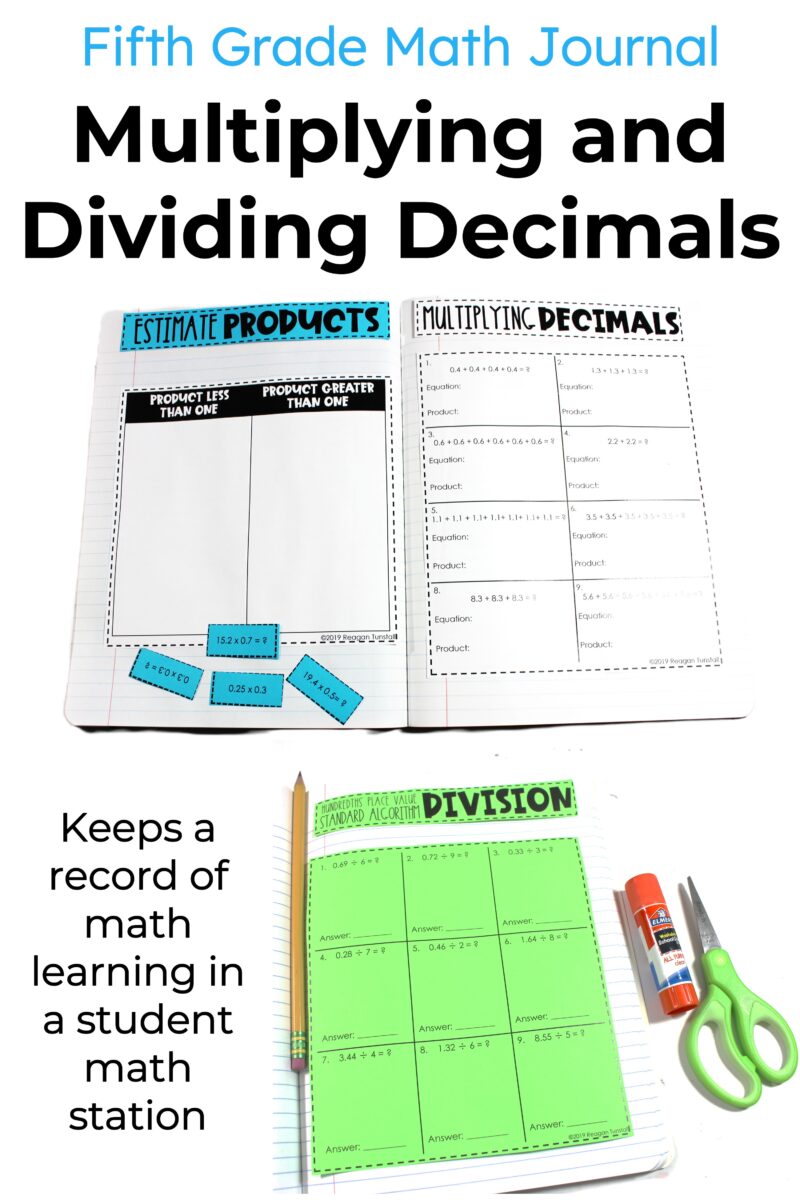 Math Journals provide a written record of the strategies students practice.
I like having this type of practice available during math workshop because it gives students an opportunity to work through a strategy and explain their thinking in writing. The Fifth Grade Multiplication Math Journal offers additional multiplication practice and word problems. For practice across the school year, explore the Fifth Grade Math Journal Yearlong Bundle or the Fifth Grade Skill Practice Pages Bundle.
Planning the Complete Fifth Grade Math Block
Multiplication and division are part of a much larger fifth-grade math year. For teachers looking for ongoing independent practice, the Fifth Grade Stations by Standard Yearlong Bundle provides centers organized across fifth-grade math domains. For a broader math workshop approach, the Fifth Grade Guided Math STACK Bundle brings together Guided Math instruction and math workshop resources. Teachers can choose the individual multiplication or division materials that match their immediate instructional needs, or explore the yearlong collections when planning across the full school year. To set up this framework in your own classroom using free icons, visit the Math Stack workstations free download post.
Connecting Fifth Grade Multiplication and Division Models, Strategies, and Independent Practice
The most meaningful multiplication and division practice happens when students can explain the mathematics behind their calculations. Hundredths grids, area models, partial products, partial quotients, estimation, and algorithms provide different ways to represent and solve problems. When students understand how the strategies connect, they have more than one way to approach an unfamiliar problem, check an answer, or explain their thinking. The two free activities in this post provide a starting point for introducing a skill, meeting with a small group, or adding meaningful multiplication and division practice to math workshop.
Never miss a tidbit
Teach More. Plan Less.
Get FREE research-based K-5 resources and fresh classroom and teaching ideas that help you make learning engaging and meaningful for your students!
18 years in the classroom, K-5 math PD presenter, and author of Guided Math AMPED. More about me